
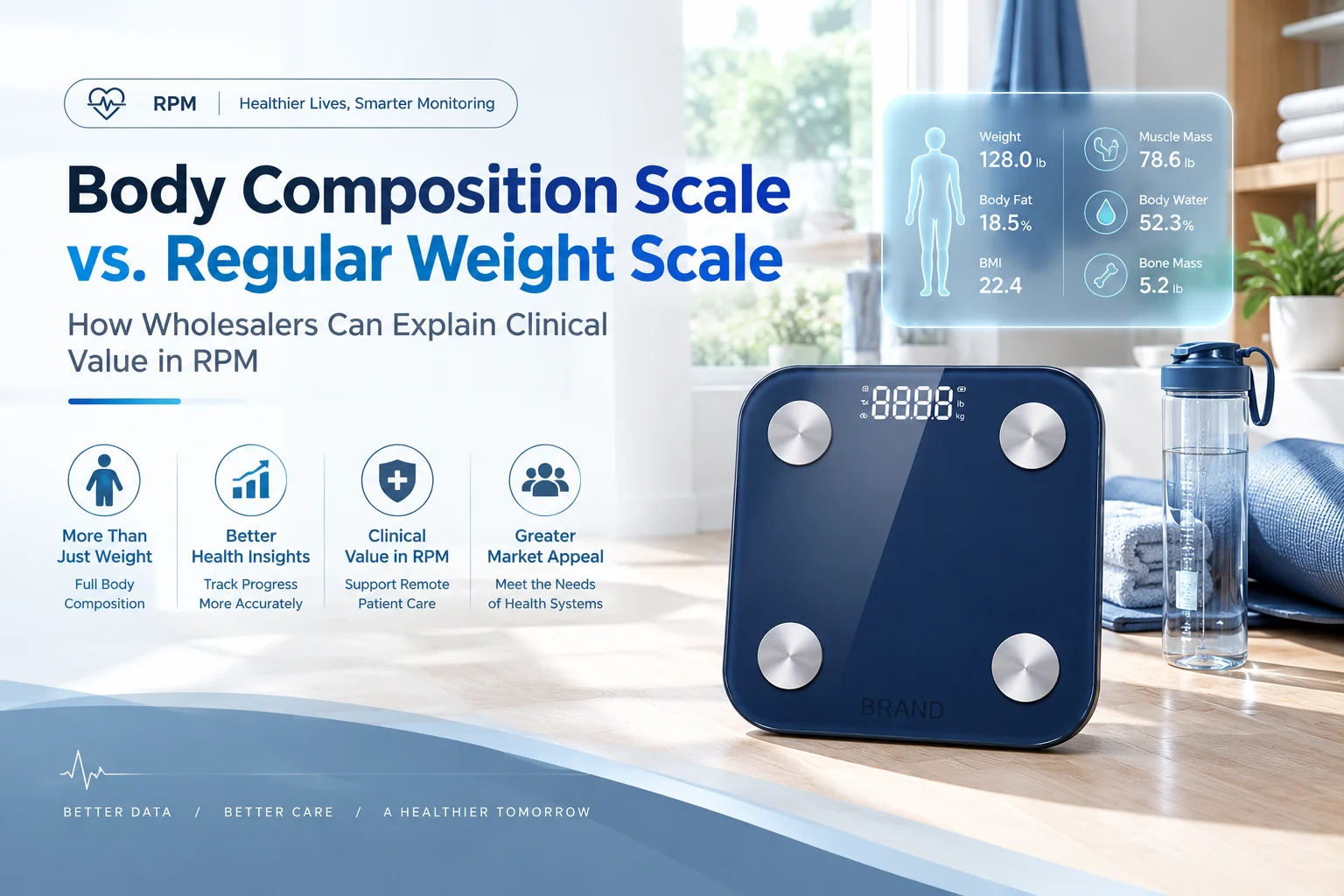
When healthcare providers evaluate a body composition scale for remote patient monitoring (RPM), they often ask a practical question: What can it tell us that a regular weight scale cannot? For medical equipment wholesalers, the answer goes beyond offering more numbers. A body composition scale can estimate fat mass, muscle mass, and body water alongside body weight, potentially giving care teams a broader view of changes in a patient’s physical condition.
However, more data does not automatically mean better clinical outcomes. The value depends on the device’s measurement capabilities, data consistency, patient population, and how clinicians interpret the results. For wholesalers supplying an RPM scale, understanding these distinctions helps explain product value accurately and match the right device to the right monitoring program.
This guide compares regular weight scales with body composition scales, explores their potential applications in heart failure monitoring and obesity management, and outlines what buyers should evaluate before purchasing connected scales in wholesale quantities.
1. What Is the Difference Between a Body Composition Scale and a Regular Weight Scale?
Both devices measure body weight, but they provide different levels of information.
A regular digital weight scale primarily measures total body weight. A body composition scale typically combines weight measurement with bioelectrical impedance analysis (BIA) or another estimation method to provide additional information about the body.
What a Regular Weight Scale Measures
A conventional digital scale provides a simple, useful measurement: how much a person weighs at a particular time.
In an RPM program, repeated weight readings can help care teams track trends and identify changes that may require follow-up. This is particularly relevant when a patient’s care plan includes regular weight monitoring.
However, body weight alone cannot explain why a person’s weight has changed.
For example, a patient may lose weight because of fat loss, muscle loss, fluid loss, or a combination of these factors. A weight-only scale cannot distinguish between these possibilities.
What a Body Composition Scale Can Add
Depending on the model, a body composition scale may provide estimates of:
Fat mass: The estimated amount of body weight attributable to fat tissue.
Muscle mass: An estimated measure of muscle-related mass, depending on the device’s calculation method.
Total body water: An estimate of the amount of water in the body.
Body fat percentage: The estimated proportion of body weight represented by fat.
Fat-free mass: An estimate of body mass excluding fat.
Other derived metrics: Some devices report additional indicators, such as visceral fat estimates or basal metabolic rate.
Not every scale provides every metric, and similarly named measurements may be calculated differently across manufacturers.
Most importantly, many consumer and clinical body composition scales estimate these values rather than measuring each tissue directly. For BIA-based devices, the estimates depend on electrical measurements, prediction equations, and assumptions about the relationship between body composition and hydration.
Clinical reviews highlight that these estimates can be useful for monitoring trends, but their accuracy depends on the device, measurement conditions, and patient characteristics.
Quick Comparison for Wholesale Buyers
| Feature | Regular Weight Scale | Body Composition Scale |
|---|---|---|
| Body weight | Yes | Yes |
| Fat mass or body fat percentage | No | Available on supported models |
| Muscle-related estimates | No | Available on supported models |
| Body water estimates | No | Available on supported models |
| Longitudinal weight tracking | Possible with connected systems | Possible with connected systems |
| Additional data for care programs | Primarily weight trends | Potentially broader body composition trends |
| Clinical interpretation | Depends on patient context | Requires attention to measurement limitations |
For wholesalers, the key distinction is not that a body composition scale replaces a regular scale. It is that selected models can add measurements relevant to specific monitoring objectives.
2. Why Body Composition Data May Matter in Remote Patient Monitoring
RPM programs use connected devices to collect patient measurements outside traditional clinical settings. Depending on the program, these measurements can be transmitted to a healthcare platform for review by authorized care teams.
A connected scale can support this process by providing repeatable measurements over time. A body composition scale may add further context when the program is designed to track changes in body composition rather than weight alone.
Moving From a Single Number to a Longitudinal View
A single measurement offers limited context. A series of measurements may reveal a trend.
For example, a care team may want to know whether a patient’s weight is gradually decreasing, whether estimated muscle mass is changing during a weight-management program, or whether body water estimates are fluctuating.
The potential value lies in reviewing trends alongside symptoms, medical history, medication changes, and other clinical information.
However, the additional metrics should be selected according to the intended clinical use. A program that primarily monitors heart failure may prioritize weight trends and clinician-defined escalation rules. A structured obesity-management program may have a stronger reason to track body composition over time.
For wholesalers: Explain which measurements a device provides and how the intended RPM program may use them. Avoid claiming that more measurements automatically improve patient outcomes.
Why Data Consistency Matters
Remote monitoring requires measurements that can be compared meaningfully over time.
Body composition estimates can vary with hydration status, recent food and fluid intake, exercise, posture, time of day, and the device’s algorithms. Different models may also produce different estimates for the same individual.
For more consistent tracking, care teams may establish a standardized measurement routine, such as measuring at a similar time of day and following the device’s instructions.
For wholesalers sourcing connected scales, this makes repeatability, user guidance, connectivity, and data integration important purchasing considerations alongside the number of metrics displayed.
3. Clinical Use Case One: Weight Monitoring in Heart Failure Programs
Heart failure is a useful example when explaining why connected scales matter in RPM. Changes in body weight can reflect fluid accumulation, which may be associated with worsening heart failure.
However, this use case also illustrates why wholesalers must distinguish between a measurement signal and a clinical diagnosis.
Why Sudden Weight Gain Matters
In some patients with heart failure, fluid retention can cause weight to increase over a short period. Clinical guidance commonly advises patients to monitor weight regularly and contact their healthcare team when weight rises unexpectedly beyond a clinician-defined threshold.
A gain of more than 2 kg over three days is one threshold used in heart failure guidance, although individual care plans may specify different triggers. Patients should follow their own care team’s instructions rather than applying a universal rule.
A regular connected scale can help identify this change by transmitting weight readings over time.
A body composition scale may provide additional body water estimates, depending on its design. Yet these estimates must be interpreted cautiously because fluid shifts can affect BIA calculations and may reduce their accuracy in patients with abnormal hydration.
Can a Body Composition Scale Detect Fluid Retention?
Not necessarily.
A standard BIA body composition scale does not automatically distinguish fluid retention caused by heart failure from ordinary changes in hydration. Some devices offer specialized fluid-related measurements, but their intended use, validation, and limitations must be assessed individually.
Research and clinical reviews caution that conventional BIA equations may be less reliable in people with abnormal hydration or fluid distribution. More advanced measurement methods may provide additional information, but their performance also depends on the population and clinical context.
For this reason, wholesalers should avoid describing every body composition scale as a heart failure fluid-monitoring device.
When evaluating an RPM scale for a heart failure program, ask:
Does the device support reliable weight transmission?
Does the care platform display weight trends and alerts?
Are any body water measurements validated for the intended population?
Can the clinical team define its own alert thresholds?
Does the device have evidence and regulatory status appropriate to its proposed use?
Buyer takeaway: For many heart failure RPM programs, reliable weight tracking and a clear clinical escalation workflow are essential. Additional body composition metrics should only be promoted when they are appropriate for the intended use and supported by evidence.
4. Clinical Use Case Two: Obesity Management and Muscle Mass Tracking
Obesity-management programs often focus on changes in body weight. However, weight alone does not reveal how much of that change comes from fat mass, muscle-related mass, or body water.
This is where a suitable body composition scale may provide additional value.
Why Weight Loss Does Not Tell the Whole Story
Consider two hypothetical patients who each lose 5 kg during a weight-management program.
One patient may experience a reduction primarily in fat mass while maintaining muscle mass. The other may lose a combination of fat and lean tissue.
Their weight changes are identical, but the underlying changes in body composition differ.
For clinicians managing obesity, nutrition, or physical activity programs, estimates of fat mass and muscle-related mass may help provide context for weight trends. The interpretation still depends on measurement quality, patient characteristics, and the overall care plan.
How Body Composition Trends Can Support Follow-Up
A body composition scale may help a program track:
Changes in estimated fat mass over several weeks or months
Trends in muscle-related estimates during weight management
Changes in body fat percentage
Whether weight changes occur alongside changes in estimated lean mass
Longer-term patterns that can be reviewed with other clinical information
These measurements should not be treated as definitive evidence of treatment success or failure. Short-term fluctuations may reflect hydration changes rather than genuine tissue gain or loss.
For more useful comparisons, healthcare teams can establish consistent measurement conditions and focus on longer-term trends rather than interpreting every reading independently.
What Wholesalers Should Explain to Buyers
When presenting a body composition scale for an obesity-management program, focus on the program’s measurement needs.
A standard scale may be sufficient if the primary goal is monitoring body weight. A body composition scale may be more appropriate when the program also plans to track estimated fat mass and muscle-related metrics.
Before recommending a device, clarify:
Which metrics the care team intends to monitor
Whether the device has been evaluated for the target population
How frequently measurements will be collected
Whether results can be exported or integrated into the care platform
How the care team will interpret and communicate changes
This approach helps buyers select a device based on clinical workflow rather than a long feature list.
5. How to Explain the Value of a Body Composition Scale to RPM Buyers
Wholesale buyers do not always need a technical explanation of bioelectrical impedance. They need to understand what the device can contribute to their program and what its limitations are.
A practical sales discussion should begin with the intended use case.
Match the Device to the Monitoring Objective
| Buyer or Program Need | Suitable Measurement Focus | Questions to Ask |
|---|---|---|
| General remote weight monitoring | Weight and longitudinal trends | Is connectivity reliable? Can clinicians review trends? |
| Heart failure RPM | Weight trends and clinician-defined escalation rules | Are alerts configurable? Is the workflow suitable for the care team? |
| Obesity management | Weight plus selected body composition estimates | Are fat and muscle-related estimates needed? |
| Nutrition or wellness programs | Weight and relevant composition metrics | Are the measurement method and intended use appropriate? |
| Integrated RPM service | Connected measurements and data workflow | Can the device integrate with the target platform? |
The right choice depends on the program’s goals, the target population, and the available clinical evidence. A more advanced scale is not automatically the better purchase for every RPM application.
Explain Features Without Overstating Clinical Benefits
Use clear, defensible language when describing product capabilities.
Instead of saying:
“This scale detects fluid retention in heart failure patients.”
A more appropriate explanation is:
“This connected scale tracks weight trends and, on supported models, provides body water estimates. Clinicians can interpret these measurements alongside symptoms and other patient information.”
Instead of saying:
“This scale proves whether a patient is losing fat or muscle.”
A more accurate explanation is:
“This scale estimates selected body composition metrics, helping care teams review longer-term trends when measurements are collected consistently.”
This distinction builds trust with healthcare providers and reduces the risk of confusing an estimated measurement with a diagnostic conclusion.
6. What Wholesalers Should Evaluate Before Buying Body Composition Scales in Bulk
For medical device distributors and RPM solution providers, product selection involves more than comparing the number of available metrics.
The device must fit the intended application, the target users, and the technical requirements of the monitoring platform.
Measurement Capability and Evidence
Confirm exactly which metrics the device measures or estimates. Ask the manufacturer for technical documentation describing the measurement method, intended use, validation evidence, and relevant limitations.
If a product is marketed for a specific clinical application, verify that its evidence and regulatory status support that claim in the target market.
Connectivity and Data Integration
A connected scale is useful only if its readings can reach the appropriate monitoring workflow.
Check whether the device supports the required connectivity method, such as cellular connectivity, Wi-Fi, or Bluetooth with a compatible gateway. Do not assume that every model supports every connection type.
For bulk procurement, also confirm:
Compatibility with the intended RPM platform
Data transmission reliability
Device identification and patient assignment workflows
Alert and trend-display capabilities
Available interfaces, APIs, or integration documentation
Data security and privacy controls
Patient Usability
The target population should influence the hardware choice.
Consider display readability, platform stability, maximum supported weight, measurement instructions, and whether patients can use the device independently.
For patients with limited technical confidence, simple operation and clear instructions may be more valuable than a large number of advanced metrics.
Procurement and Support
Before placing a wholesale order, request information on:
MOQ and volume pricing
Sample availability
Production and delivery lead times
Warranty and after-sales support
Documentation and training materials
Packaging and device labeling
Regulatory documentation for the destination market
Firmware, platform, and integration support
These details help determine whether a product can support a scalable RPM deployment rather than merely meet a device specification.
7. Common Misconceptions About Body Composition Scales
Misconception 1: More Metrics Always Mean Better Clinical Monitoring
Additional measurements can provide context, but they also create more data to interpret. A metric is valuable only when it is sufficiently reliable and relevant to the program’s goals.
Better approach: Select measurements according to a defined clinical workflow.
Misconception 2: Body Water Estimates Directly Diagnose Fluid Overload
A body water estimate is not the same as a diagnosis of fluid overload. Conventional BIA calculations can be affected by abnormal hydration and fluid distribution.
Better approach: Treat device readings as supporting information and follow the clinical team’s assessment and escalation protocol.
Misconception 3: Muscle Mass Estimates Are Direct Measurements
Many scales derive muscle-related values from impedance measurements and prediction equations. These estimates may vary between devices and measurement conditions.
Better approach: Use the same device and a consistent protocol for longitudinal comparisons, and interpret results within the limits of the device’s validation.
Misconception 4: A Connected Scale Automatically Creates an Effective RPM Program
Connectivity enables data transmission, but it does not guarantee that readings are reviewed, alerts are acted upon, or clinical outcomes improve.
Better approach: Evaluate the complete workflow, including patient onboarding, data review, alert handling, escalation, and follow-up.
Conclusion: Sell the Right Measurement Capability for the Right RPM Program
The difference between a regular weight scale and a body composition scale is not simply the number of measurements displayed. A regular scale provides an important baseline for tracking body weight, while a suitable body composition scale can add estimates of fat mass, muscle-related mass, and body water.
For heart failure monitoring, weight trends remain important, while body water estimates require particular caution in patients with abnormal fluid balance.
For obesity management, body composition trends may provide useful context beyond total weight, provided the measurements are consistent and interpreted appropriately.
When evaluating an RPM scale for wholesale procurement, prioritize clinically appropriate measurements, reliable data transmission, clear documentation, and a workable care-team workflow. These factors offer a more defensible basis for product selection than metric count alone.