
Remote Patient Monitoring (RPM) program managers, telehealth logistics directors, and clinical operations leaders face a continuous operational challenge: maintaining uninterrupted patient data transmission across diverse geographic regions. In cellular-enabled home health monitoring, transmitting daily pulse oximetry readings directly to clinician portals requires dependable wireless connectivity regardless of where the patient lives or travels. Consequently, healthcare procurement officers frequently ask telemonitoring hardware suppliers a core connectivity question: “Is a single-carrier SIM card sufficient for a cellular pulse oximeter, and what tangible operational value does an auto-switching multi-carrier IoT SIM deliver to a remote patient monitoring program?”
Deploying cellular monitoring hardware locked to a single carrier network leads to signal dead zones, patient frustration, dropped readings, and failed Medicare billing compliance. For home health monitoring, utilizing an intuitive one-button RPM oximeter for home use equipped with a multi-carrier IoT SIM card eliminates connection barriers, ensuring seamless health data transmission in both urban centers and underserved rural areas. Understanding how multi-carrier auto-switching operates, how dedicated M2M cellular bands protect data integrity, and how connectivity impacts monthly reimbursement compliance enables healthcare procurement teams to select reliable remote monitoring hardware. This technical guide examines network coverage mechanics, billing compliance physics, cellular M2M architecture, and procurement criteria for cellular health monitors.
1. The Single-Carrier Bottleneck: Coverage Gaps and Medicare Compliance Risks
In the United States, cellular network coverage varies significantly across regional and rural landscapes. A single network provider rarely maintains total dominance across every suburban neighborhood, mountainous community, or rural county.
The 16-Day Medicare Billing Threshold
Under CPT codes 99453 and 99454, Medicare reimbursement for remote patient monitoring requires patients to transmit vital signs data on at least 16 days within a 30-day billing cycle.
Connection Failure Risk: If a patient receives a cellular pulse oximeter locked to a single carrier with weak coverage at their residence, readings fail to upload automatically.
Financial and Clinical Impact: Missing the 16-day transmission threshold invalidates CPT 99454 reimbursement for that patient month, causing direct revenue loss for healthcare providers and interrupting clinical oversight for high-risk patients.
The Value of a One-Button RPM Oximeter for Home Use
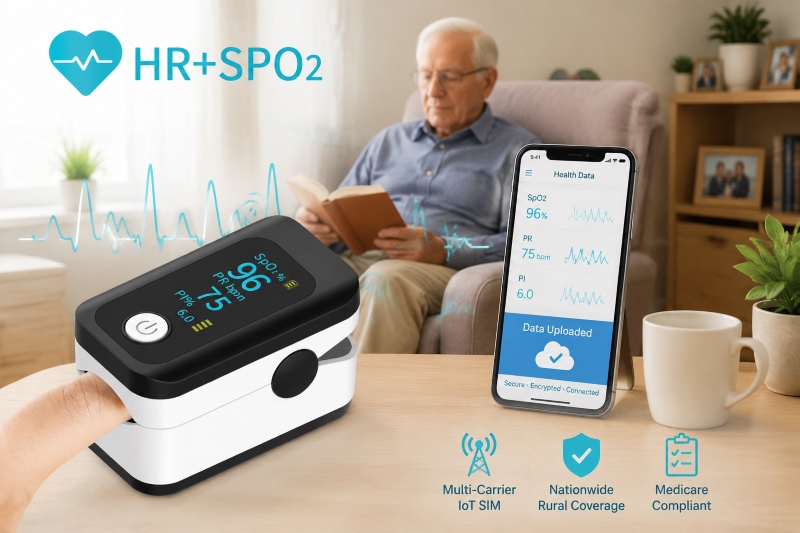
To maximize compliance, elderly or non-tech-savvy patients require an effortless user experience. A one-button RPM oximeter for home use allows patients to simply slip the device onto their finger and press a single button. If paired with an intelligent multi-carrier SIM, the device turns on, measures SpO2 and pulse rate, selects the strongest local cell tower, and transmits data to the cloud automatically—requiring zero Bluetooth pairing, zero home Wi-Fi setup, and zero manual carrier selection.
2. Engineering Value: How Multi-Carrier Auto-Switching Operates
Rather than locking a medical device to a single cellular network, a multi-carrier eUICC / M2M IoT SIM provisions access to major national cellular networks (such as AT&T, T-Mobile, and Verizon) on a single chip.
Single-Carrier SIM vs. Multi-Carrier IoT SIM for RPM Connectivity
Reliable network connectivity plays a critical role in remote patient monitoring (RPM) devices. The choice between a single-carrier SIM and a multi-carrier IoT SIM directly affects data transmission stability, especially in rural areas and locations with inconsistent cellular coverage.
| Network Architecture | Signal Selection Method | Connectivity Performance |
|---|---|---|
| Single-Carrier SIM | The device connects to one fixed cellular network only. | Connectivity may drop when the selected carrier has weak coverage or signal strength falls below optimal levels. |
| Multi-Carrier IoT SIM (eUICC) | The SIM automatically switches between multiple carrier networks based on real-time signal conditions, including RSRP measurements. | Provides more reliable connectivity by selecting the strongest available network across different locations. |
How Multi-Carrier eUICC Technology Improves RPM Reliability
Traditional single-carrier SIM solutions rely on one network connection. Therefore, devices may experience communication interruptions in rural areas, remote locations, or during patient travel.
In contrast, multi-carrier IoT SIM technology uses eUICC architecture to support flexible network selection. The system evaluates available carrier signals and automatically connects to the strongest network option.
As a result, RPM devices can maintain more consistent data transmission, improve monitoring reliability, and reduce connectivity-related service interruptions.
1. Universal Coverage via Dynamic Network Triangulation
Upon powering on, the cellular modem scans surrounding cell towers and measures Reference Signal Received Power (RSRP). The IoT SIM automatically registers onto the strongest available network. If a patient travels or lives in a rural area where one provider lacks tower density, the device switches seamlessly to an alternative carrier.
2. Zero-Configuration Patient Experience
Remote patient monitoring programs often serve elderly patients managing chronic conditions like COPD or heart failure. An auto-switching multi-carrier SIM operates entirely in the background. The patient experiences zero technical friction, eliminating support calls to clinical staff regarding network setups or connection troubleshooting.
3. Data Continuity Across Geographic Shifts
Whether a patient visits family in another state or resides in an isolated rural valley, multi-carrier fallback ensures that daily SpO2 and heart rate readings upload reliably, maintaining the continuous data record necessary for clinical intervention and monthly billing qualification.
3. Technical Comparison: Single-Carrier SIM vs. Multi-Carrier M2M IoT SIM
The table below contrasts single-carrier consumer-grade SIM configurations against multi-carrier M2M IoT SIM architecture in medical telemonitoring:
| Engineering & Operational Metric | Single-Carrier Consumer SIM | Multi-Carrier M2M / IoT SIM |
| Network Provider Access | Single provider only (e.g., AT&T or T-Mobile) | Multi-network access (AT&T, T-Mobile, Verizon) |
| Rural Coverage & Dead Zone Resilience | Poor; subject to local carrier blind spots | Optimal; automatically failovers to the strongest tower |
| Medicare 16-Day Compliance Safeguard | Low coverage drops cause missed transmissions | High; ensures reliable daily data uploads |
| Cellular Band Priority | Shared consumer bandwidth (subject to congestion) | Dedicated M2M / IoT bands (Cat-M1 / NB-IoT) |
| Data Encryption & Security | Standard public APN routing | Private APN, end-to-end encrypted data tunnel |
| Patient Technical Onboarding | High friction if network troubleshooting is needed | Zero-touch onboarding; 100% plug-and-play |
4. Advantages of Dedicated M2M / IoT Cellular Bands (Cat-M1 & NB-IoT)
Beyond carrier redundancy, medical-grade cellular devices utilize dedicated M2M (Machine-to-Machine) spectrum technologies, specifically LTE Cat-M1 and NB-IoT (Narrowband IoT):
Bandwidth Congestion Bypass: Consumer mobile phones compete for high-speed data bandwidth during peak hours, causing network congestion. M2M IoT channels operate on dedicated narrow frequencies, ensuring medical vitals transmit immediately without network throttling.
Deep In-Building Signal Penetration: LTE Cat-M1 and NB-IoT protocols feature enhanced signal propagation power (up to +20 dB gain over standard LTE), allowing signals to penetrate thick concrete walls, basements, and shielded rural homes.
Medical-Grade Security Standards: M2M SIM configurations route health data through private Access Point Names (APN) and encrypted VPN tunnels directly to HIPAA-compliant cloud servers, safeguarding Protected Health Information (PHI) against public internet exposure.
-3.webp)
5. Procurement Checklist for RPM Oximeters
Healthcare procurement managers, RPM distributors, and clinical logistics specialists should evaluate three core technical criteria before selecting cellular monitoring hardware:
Verify Global or Regional Multi-Carrier Provisioning: Ensure the SIM profile utilizes eUICC technology with pre-funded multi-carrier agreements covering all target deployment zip codes without requiring physical SIM swaps.
Prioritize Simple User Interface Mechanics: Select a one-button RPM oximeter for home use with an integrated, high-contrast LED/OLED display. Simple hardware design combined with automated background cellular transmission dramatically increases patient compliance among elderly users.
Inspect Medical Device & Regulatory Approvals: Ensure pulse oximetry hardware holds necessary medical regulatory clearances (FDA 510(k), CE MDR, ISO 13485) and meets strict SpO2 accuracy standards (± 2\% range between 70\% – 100\% SpO2) across motion and low-perfusion states.
Technical Summary
Deploying a one-button RPM oximeter for home use powered by a multi-carrier IoT SIM solves the critical challenge of rural network coverage in remote patient monitoring. By providing dynamic network switching across major cellular carriers, dedicated M2M band prioritization, and zero-touch patient onboarding, multi-carrier cellular monitors ensure uninterrupted daily data transmission. This connectivity architecture safeguards clinical oversight while enabling healthcare providers to consistently meet Medicare’s 16-day transmission requirement for monthly CPT reimbursement. AOJ designs and manufactures FDA-cleared cellular pulse oximeters, multi-carrier RPM medical devices, and integrated telemonitoring solutions engineered for global healthcare providers and telehealth platforms.