
The expansion of Remote Patient Monitoring (RPM) across U.S. safety-net healthcare providers is changing how Federally Qualified Health Centers (FQHCs) and Rural Health Clinics (RHCs) evaluate remote monitoring technology.
As Medicare reimbursement moves away from historically bundled payment structures toward individual fee-for-service CPT codes, consistent and verifiable patient data transmission has become increasingly important to RPM programs.
For healthcare networks, RPM software providers, and medical device procurement teams, this creates a practical hardware question:
How can an RPM device maximize patient adherence without depending on smartphones, home Wi-Fi, or complex technical setup?
For rural, elderly, and underserved populations, the answer increasingly points toward 4G LTE cellular RPM devices.
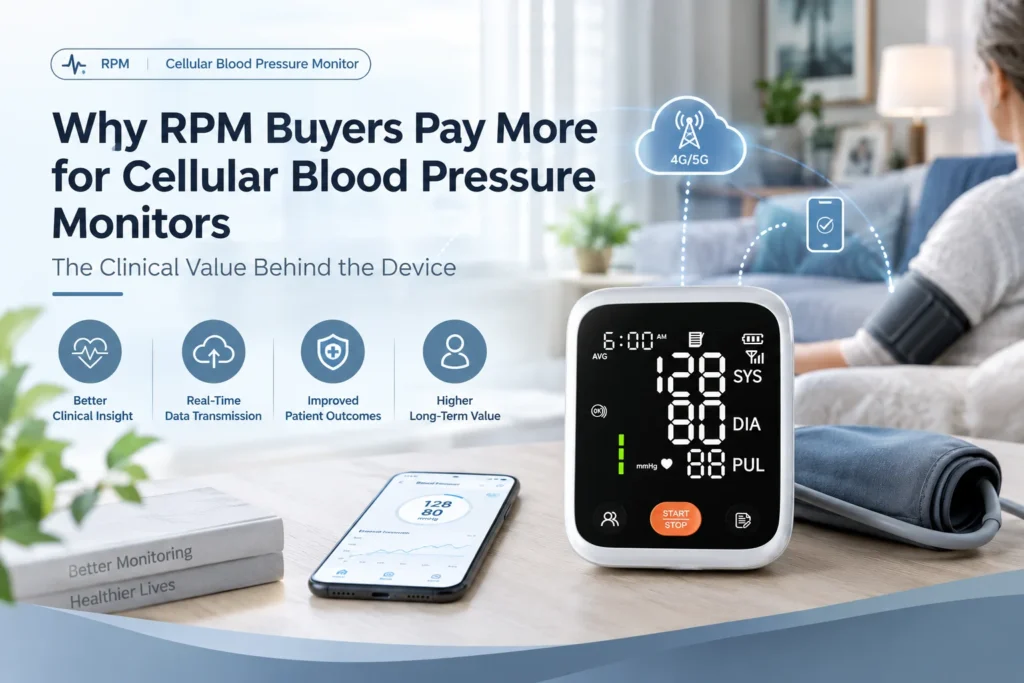
Unlike Bluetooth-connected devices that depend on a smartphone and app, cellular medical devices can transmit measurements directly to a cloud platform. This creates a simpler patient workflow while reducing connectivity and technical-support barriers.
For B2B RPM deployments, the combination of zero-setup connectivity, automated data transmission, and multi-carrier cellular networking makes 4G LTE blood pressure monitors particularly relevant to large-scale FQHC and RHC programs.
1. Medicare RPM Reimbursement Changes Increase the Importance of Patient Data Transmission
The reimbursement structure described in this article represents an important shift for FQHCs and RHCs.
Historically, RPM services for these safety-net providers were associated with bundled reimbursement under HCPCS G0511. Under the current 2026 framework described here, providers can instead bill individual Medicare CPT codes, including:
CPT 99453 — Initial setup and patient education
CPT 99454 — Device supply and transmission
CPT 99445 — Device supply for 2–15 days of readings
CPT 99457 — Monthly RPM treatment management
CPT 99470 — 10–19 minutes of monthly care management
CPT 99458 — Additional monthly treatment management time
This shift makes individual components of an RPM workflow more directly connected to documented patient participation and service delivery.
Medicare RPM Reimbursement Framework for FQHCs and RHCs
| Billing Factor | Historical Model (Pre-2025) | Current 2026 Policy |
|---|---|---|
| Billing Structure | Single bundled code (G0511) | Individual CPT codes including 99453, 99454, 99445, 99457, 99470, and 99458 |
| Setup Reimbursement | Absorbed into flat fee | Itemized through CPT 99453 |
| Monthly Device Supply | Bundled payment with lower-threshold tracking | CPT 99454 for 16+ days or CPT 99445 for 2–15 days |
| Management Time | Mixed care coordination | Stratified by time, including CPT 99470 for 10–19 minutes and CPT 99457 for 20+ minutes |
| Hardware Importance | Less directly tied to individual transmission performance | More closely connected to successful data collection and transmission |
The practical implication for healthcare organizations is significant.
When reimbursement depends on successful RPM workflows, device connectivity and patient adherence become operational considerations rather than purely technical specifications.
2. Why RPM Hardware Connectivity Matters to FQHC and RHC Networks
The reimbursement model creates a direct relationship between RPM hardware performance and the clinic’s ability to collect usable patient data.
Consider a rural patient using a conventional Bluetooth blood pressure monitor.
The patient may need to:
Turn on the blood pressure monitor.
Open a smartphone.
Launch the RPM application.
Enable Bluetooth.
Pair the device.
Complete the measurement.
Keep the smartphone available for synchronization.
Resolve connection problems when synchronization fails.
For a technically experienced patient, this workflow may be manageable.
For elderly, low-literacy, or underserved populations, every additional step introduces another potential failure point.
If a Bluetooth monitor does not successfully synchronize with the patient’s smartphone, the measurement may remain stored locally rather than reaching the RPM platform.
This is why remote patient monitoring hardware selection can directly influence adherence performance.
3. Why 4G LTE Cellular RPM Devices Reduce the Patient Setup Burden
A cellular RPM device changes the architecture by moving network connectivity from the patient’s smartphone or home router into the medical device itself.
Instead of:
Medical Device → Bluetooth → Smartphone → App → Internet → Cloud
the cellular model uses:
Medical Device → 4G LTE → Cloud Platform
This direct-to-cloud architecture eliminates several dependencies.
Cellular RPM Adherence Pipeline
| Stage | Traditional Bluetooth Workflow | 4G LTE Cellular Workflow |
|---|---|---|
| Patient Measurement | Patient measures blood pressure | Patient measures blood pressure |
| Local Connection | Bluetooth pairing required | No Bluetooth pairing |
| Smartphone | Required | Not required |
| RPM App | Required for synchronization | Not required for transmission |
| Home Wi-Fi | May be required depending on architecture | Not required |
| Network Connection | Depends on smartphone and local network | Built into the device |
| Data Upload | Patient-dependent synchronization | Automatic cellular transmission |
| Patient Setup | Multiple steps | Plug-and-play |
| Primary Technical Risk | Pairing, app, OS, Wi-Fi, or phone issues | Cellular coverage limitations |
For rural and underserved populations, this reduction in technical dependencies can simplify deployment considerably.
4. The Main Patient Adherence Barriers in Rural and Underserved Communities
FQHCs and RHCs frequently serve populations with different technology access levels than digitally mature urban healthcare environments.
Common challenges include:
Limited access to reliable home Wi-Fi
Spotty broadband coverage
Older smartphones
Smartphone compatibility issues
Limited digital literacy
Difficulty installing and configuring applications
Bluetooth pairing problems
Patients forgetting to synchronize measurements
These barriers can create additional workload for clinical and technical support teams.
4.1 Eliminating the Smartphone Dependency
Bluetooth RPM devices typically depend on a smartphone to serve as the communication bridge.
This introduces several potential problems, including:
Bluetooth being disabled
Lost device pairing
Operating system updates
App compatibility problems
Smartphone replacement
Background app restrictions
A cellular blood pressure monitor removes the smartphone from the transmission chain.
The patient can therefore focus on the clinical task—taking the measurement—rather than managing the technology required to upload it.
4.2 Eliminating Home Wi-Fi Dependency
Wi-Fi-connected RPM devices require access to a functioning broadband router.
That can be a problem for patients living in rural or low-connectivity areas.
A cellular IoT device instead uses its integrated mobile network connection to transmit data directly to the cloud.
This makes the device more suitable for environments where broadband access is inconsistent or unavailable.
The 16-Day Transmission Requirement Makes Automatic Upload More Valuable
One of the most important operational considerations in the reimbursement model described in this article is the 16-day transmission threshold.
For monthly CPT 99454 reimbursement, patients must transmit at least 16 days of physiological readings within a 30-day window.
The availability of CPT 99445, covering 2–15 days of readings, provides an additional billing option for onboarding periods or months with partial participation.
However, reliable data transmission remains critical.
How Connectivity Can Affect RPM Data Collection
| Patient Behavior | Bluetooth RPM | 4G LTE Cellular RPM |
|---|---|---|
| Takes blood pressure measurement | ✓ | ✓ |
| Needs smartphone | Yes | No |
| Needs Bluetooth pairing | Yes | No |
| Needs manual synchronization | Potentially | No |
| Depends on home Wi-Fi | Potentially | No |
| Automatic data transmission | Limited by connected devices | Yes |
| Risk of technology-related missed transmission | Higher | Lower |
| Support requirements | Higher | Lower |
The purpose of cellular connectivity is therefore not simply to provide a different communication method.
It is to remove unnecessary patient-side steps between measurement and cloud transmission.
AOJ 4G LTE Blood Pressure Monitors for Direct-to-Cloud RPM
For B2B healthcare organizations, connectivity alone is not enough.
A deployable RPM device must also support clinical accuracy, network compatibility, software integration, and simple patient operation.
AOJ’s 4G LTE blood pressure monitors are designed around these requirements, providing a cellular hardware foundation for RPM software platforms, healthcare networks, and FQHC/RHC deployments.
Clinical Accuracy and Regulatory Compliance
AOJ combines cellular connectivity with blood pressure measurement technology designed for remote healthcare applications.
FDA 510(k) Clearance
The AOJ device is identified with FDA 510(k) clearance K260276, supporting deployment requirements for U.S. healthcare applications.
Precision Blood Pressure Measurement
The monitors use advanced oscillometric algorithms designed to provide consistent blood pressure and pulse measurements for hypertensive patient populations.
For RPM buyers, this combination is important because the device must function as both:
A reliable medical measurement device
A connected remote monitoring endpoint
Multi-Carrier 4G LTE Connectivity for U.S. RPM Deployment
A major advantage of cellular RPM hardware is that network connectivity is integrated directly into the device.
AOJ 4G LTE blood pressure monitors feature a built-in M2M/IoT SIM designed to automatically connect to major U.S. carrier networks, including:
AT&T
T-Mobile
Verizon
This multi-carrier architecture helps simplify nationwide deployment by reducing dependence on a single carrier network.
Direct Medical Device-to-Cloud Transmission
The device uses cellular IoT connectivity to transmit patient measurements directly from the home to the designated cloud backend.
This architecture is particularly valuable for patients who:
Do not have reliable home broadband
Do not regularly use smartphones
Have limited technical skills
Require simplified RPM workflows
Live in rural or underserved communities
The cellular connection therefore becomes part of the device’s core healthcare infrastructure rather than an external accessory.
API and SDK Integration for RPM Software Platforms
Healthcare networks rarely operate RPM devices in isolation.
Most B2B deployments require the medical device to exchange data with an existing software ecosystem.
AOJ provides API and SDK integration documentation to support data routing into:
Custom RPM dashboards
Healthcare provider portals
Telehealth platforms
EHR systems
Cloud-based healthcare applications
Developer-Ready Connectivity Architecture
The basic data flow can be structured as:
Blood Pressure Monitor → 4G LTE Network → Cloud Backend → API/SDK → RPM Platform / EHR
This architecture helps software providers integrate device telemetry without creating an entirely new communication layer for each deployment.
The objective is to shorten the path from pilot testing to production deployment.
Patient-Centered Design for Elderly and Low-Literacy Users
Connectivity becomes less valuable if the patient cannot operate the device easily.
For this reason, patient usability remains an important consideration when selecting RPM hardware.
AOJ’s connected blood pressure monitors incorporate:
One-Touch Operation
A minimalist one-touch interface reduces the number of actions required from the patient.
This design is particularly suitable for users with limited digital literacy or visual limitations.
Large Backlit LCD Display
The oversized backlit LCD improves measurement visibility and makes the results easier to read during independent home monitoring.
Ergonomic Arm Cuff
The wide-range ergonomic arm cuff is designed to support comfortable home measurements across different users.
Together, these features help shift the RPM workflow away from technology management and toward the actual clinical measurement.
AOJ Cellular RPM Hardware vs. Traditional Bluetooth Devices
For healthcare networks evaluating large-scale RPM deployment, the differences become clearer when comparing the two architectures across operational metrics.
| Deployment Metric | Traditional Bluetooth Hardware | AOJ 4G LTE Cellular Hardware |
|---|---|---|
| Patient Setup Time | 15–30 minutes with guided setup | 0 minutes, out-of-the-box |
| Smartphone Requirement | Required | Not required |
| Bluetooth Pairing | Required | Not required |
| Home Wi-Fi Dependency | Potentially required | Not required |
| Technical Support Burden | High due to pairing, app, and Wi-Fi issues | Minimal with cellular auto-connect |
| 16-Day Adherence Success | Variable and reliant on smartphone workflow | High with automated direct transmission |
| Target Population | Tech-literate urban/suburban users | Rural, elderly, and underserved populations |
| Data Architecture | Client-side synchronization | Direct cellular-to-cloud transmission |
| Software Integration | Fragmented client-side SDKs | Unified cloud API / webhook pipeline |
| Network Connectivity | Smartphone/Wi-Fi dependent | Built-in multi-carrier cellular connectivity |
The distinction is particularly important for B2B deployments.
A healthcare provider purchasing hundreds or thousands of RPM devices must evaluate not only the unit cost of the hardware but also the operational cost of supporting patients after deployment.
What RPM Hardware Buyers Should Consider
For RPM software providers, FQHC networks, RHCs, and healthcare organizations, selecting a connected blood pressure monitor should involve more than comparing device specifications.
A practical procurement evaluation should examine five areas.
1. Patient Setup
Determine whether patients need a smartphone, application, Bluetooth pairing, or Wi-Fi configuration.
2. Cellular Connectivity
Confirm whether the device includes integrated M2M/IoT connectivity and which U.S. carrier networks it supports.
3. Automatic Data Transmission
Evaluate whether measurements can reach the cloud automatically without patient intervention.
4. Software Integration
Verify API, SDK, webhook, and cloud integration capabilities before committing to large-scale deployment.
5. Patient Usability
Consider whether elderly and low-literacy patients can independently operate the device, read the display, and complete measurements correctly.
These factors determine whether an RPM device can move successfully from a small pilot program to a large-scale healthcare deployment.
Why Cellular Connectivity Is Becoming Strategic for FQHC and RHC RPM
The convergence of reimbursement requirements, patient demographics, and connectivity limitations creates a strong business case for cellular RPM hardware.
The fundamental challenge is not simply:
“How do we measure blood pressure remotely?”
The larger challenge is:
“How do we ensure that patients can consistently measure and transmit their data without requiring technical assistance?”
For digitally confident patients, Bluetooth and smartphone-based systems can remain practical.
For rural, elderly, and underserved populations, however, every additional technical step can become a potential adherence barrier.
A cellular blood pressure monitor addresses this problem by moving connectivity into the medical device itself.
Conclusion: Build RPM Around the Patient, Not the Smartphone
The Medicare RPM reimbursement transition described in this article creates a stronger connection between patient participation, data transmission, and healthcare reimbursement for FQHCs and RHCs.
Flexible coding options such as CPT 99445 and CPT 99470, together with the individual CPT framework including 99453, 99454, 99457, and 99458, create new opportunities for community and rural healthcare organizations to expand RPM programs.
But reimbursement opportunities alone do not guarantee successful RPM deployment.
For underserved populations, the technology must be simple enough to use consistently.
This is where 4G LTE cellular blood pressure monitors provide a strategic advantage. By eliminating smartphone pairing, reducing Wi-Fi dependency, and automatically transmitting measurements through cellular networks, these devices can simplify the patient experience while reducing technical barriers for healthcare providers.
AOJ’s 4G LTE blood pressure monitors combine:
FDA 510(k) clearance K260276
Advanced oscillometric measurement technology
Built-in multi-carrier M2M/IoT connectivity
Support for AT&T, T-Mobile, and Verizon
Direct cellular-to-cloud data transmission
API/SDK integration capabilities
One-touch patient operation
Oversized backlit LCD
Ergonomic wide-range arm cuff
For RPM software companies, healthcare networks, FQHCs, and RHCs seeking to expand remote monitoring into rural and underserved populations, cellular connectivity is not simply a communication feature—it is a core component of the RPM deployment strategy.
Partner with AOJ for Connected RPM Hardware
AOJ provides B2B 4G LTE blood pressure monitoring hardware designed for integration with remote patient monitoring platforms and healthcare networks. With cellular connectivity, cloud integration capabilities, and patient-centered operation, AOJ supports scalable RPM deployments where simplicity and reliable data transmission are critical.