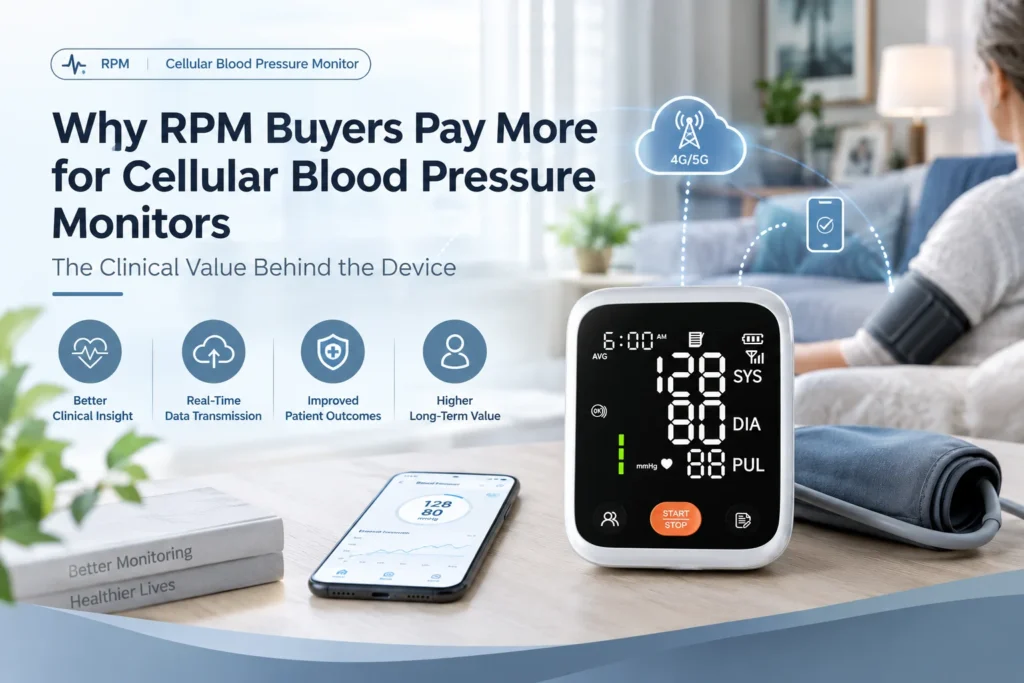

Healthcare providers, RPM platform managers, and telehealth procurement directors evaluating hardware face a core architecture question: “Should our Remote Patient Monitoring (RPM) program deploy Bluetooth, Wi-Fi, or Cellular IoT blood pressure monitors?”
While Bluetooth monitors offer lower initial hardware costs, they depend on smartphones, app pairings, and active user intervention—frequently causing data transmission failures among elderly patients. Wi-Fi devices introduce setup friction, requiring home network configurations that fail in senior living or rural environments. Ultimately, healthcare organizations are not purchasing a connectivity protocol; they are purchasing data transmission probability.
This technical architecture guide compares Bluetooth, Wi-Fi, and cellular IoT RPM blood pressure monitors, demonstrating why zero-setup cellular architecture maximizes patient adherence and secures Medicare CPT billing compliance.
1. Architectural Comparison: Connectivity Protocols in RPM Deployments
Evaluating connectivity protocols across patient usability, setup complexity, and data delivery highlights why cellular architecture outperforms short-range wireless technologies:
| Feature Parameter | Bluetooth (BLE) | Wi-Fi (802.11) | Cellular IoT (4G LTE) |
|---|---|---|---|
| Patient Setup Requirement | High — Requires smartphone app and Bluetooth pairing | High — Requires SSID selection and password entry | Zero — Plug & play with pre-activated eSIM |
| Dependency | Requires smartphone and background app running | Requires home broadband router | Independent device with built-in M2M network |
| Primary Failure Point | OS updates, lost pairing, or Bluetooth turned off | Wrong password or network changes | Out-of-coverage rural dead zones (rare) |
| Data Transmission | Low to Moderate — Data may remain trapped on the phone | Moderate — Connection dropouts may occur | High — True zero-touch automatic upload |
| CPT Billing Safety (16-Day Requirement) | High risk of missed transmission days | Moderate risk of transmission dropouts | Optimized for the 16-day adherence threshold |
2. The Transmission Bottleneck: Why Short-Range Wireless Fails Elderly RPM
Examining deployment obstacles across Bluetooth, Wi-Fi, and Cellular IoT architectures reveals why short-range wireless protocols reduce program retention:
Bluetooth (BLE): The Smartphone Pairing Trap
Bluetooth-enabled blood pressure monitors rely on patient-owned smartphones. This architecture introduces multiple points of failure:
App & OS Friction: OS updates disable background Bluetooth permissions, clearing device pairings without warning.
User Capability Barrier: Elderly patients struggling with cognitive or visual impairments often turn off Bluetooth, close the companion app, or fail to sync data, trapping clinical readings on the smartphone.
Wi-Fi: Configuration Complexity & Environment Limits
Wi-Fi monitors eliminate the smartphone requirement after initial pairing, but introduce home network dependencies:
Complex Onboarding: Typing long Wi-Fi passwords on small device screens or companion apps leads to high onboarding dropouts.
Network Instability: Changing router passwords, ISP outages, or deployments in assisted living facilities lacking public Wi-Fi disrupt daily data transmission.
Cellular IoT (4G LTE): The Zero-Touch Architectural Advantage
Cellular M2M architecture operates independently of local home infrastructure:
True Out-of-the-Box Operation: The device arrives pre-configured with an integrated, multi-carrier IoT SIM card auto-connecting to top US networks (AT&T, T-Mobile, Verizon).
Frictionless Data Upload: Patients press a single button to measure their blood pressure. The device encrypts and uploads vitals directly to the cloud within seconds, requiring zero smartphone apps, password inputs, or pairing steps.
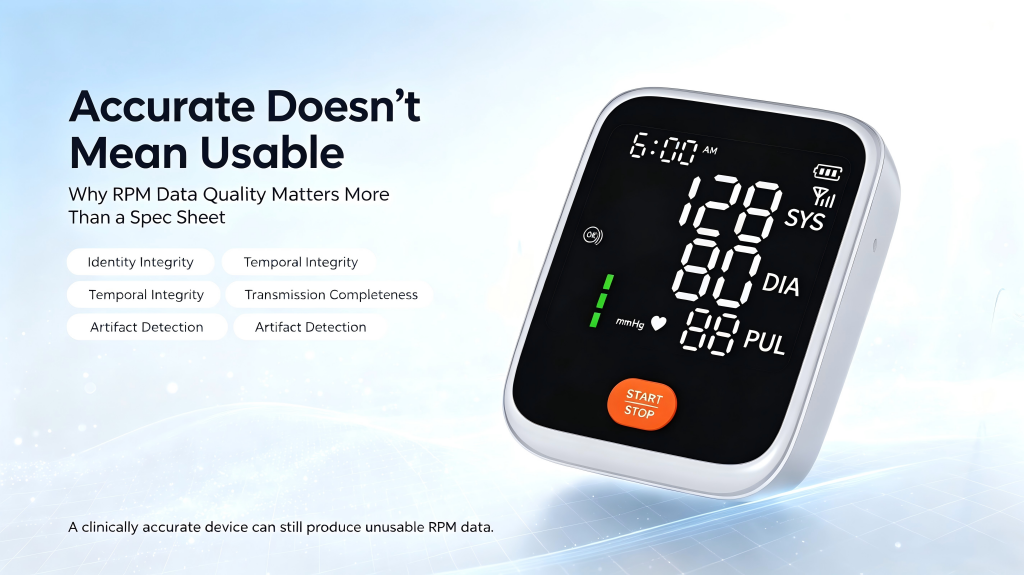
3. Securing Medicare CPT Billing Compliance (CPT 99453 & CPT 99454)
For US healthcare networks and RPM platform providers, hardware choice directly impacts financial sustainability under Medicare guidelines:
The 16-Day Data Requirement (CPT 99454): Reimbursing remote patient monitoring under Medicare CPT 99454 requires collecting and transmitting at least 16 days of physiological readings within 30 days.
Protecting Recurring Revenue: When Bluetooth or Wi-Fi connectivity drops, patients miss readings—dropping below the 16-day threshold and invalidating monthly billing claims.
Maximizing Program ROI: Deploying zero-setup 4G LTE cellular hardware ensures consistent daily transmissions, protecting monthly reimbursement revenue across patient cohorts.
4. AOJ 4G LTE Cellular Blood Pressure Monitor Features & Integration
AOJ engineers clinical-grade cellular IoT RPM blood pressure monitors designed for seamless integration with US RPM platforms and healthcare networks:
a. Clinical Precision & FDA 510(k) Cleared
FDA 510(k) clearance (K260276) verifies diagnostic-grade measurement accuracy using advanced oscillometric algorithms, meeting clinical standards required by health systems.
b. Multi-Carrier US Cellular IoT Connectivity
Equipped with integrated multi-carrier eSIM/SIM chips that dynamically select the strongest signal across AT&T, T-Mobile, and Verizon networks. Dedicated M2M bands ensure reliable coverage in rural and suburban areas.
c. Developer-Ready Architecture (API / SDK)
Comprehensive API/SDK documentation enables technical teams to route encrypted patient vitals directly into proprietary RPM dashboards, custom clinical portals, or leading EHR systems within days.
d. Senior-Centric Ergonomic Hardware Design
Features an oversized backlit LCD, intuitive one-touch control, and a wide-range ergonomic cuff designed for simple, independent home use by elderly patients.
Technical Summary
Selecting a cellular IoT RPM blood pressure monitor transitions your hardware procurement from a simple cost comparison to an optimized architectural choice. While Bluetooth and Wi-Fi introduce setup barriers, independent 4G LTE cellular devices eliminate onboarding friction. Maximize patient adherence, and secure Medicare CPT billing compliance (CPT 99453/99454).
AOJ supplies FDA 510(k) cleared cellular blood pressure monitors, RPM hardware integration, and telehealth devices for US healthcare networks, digital health platforms, and RPM providers.