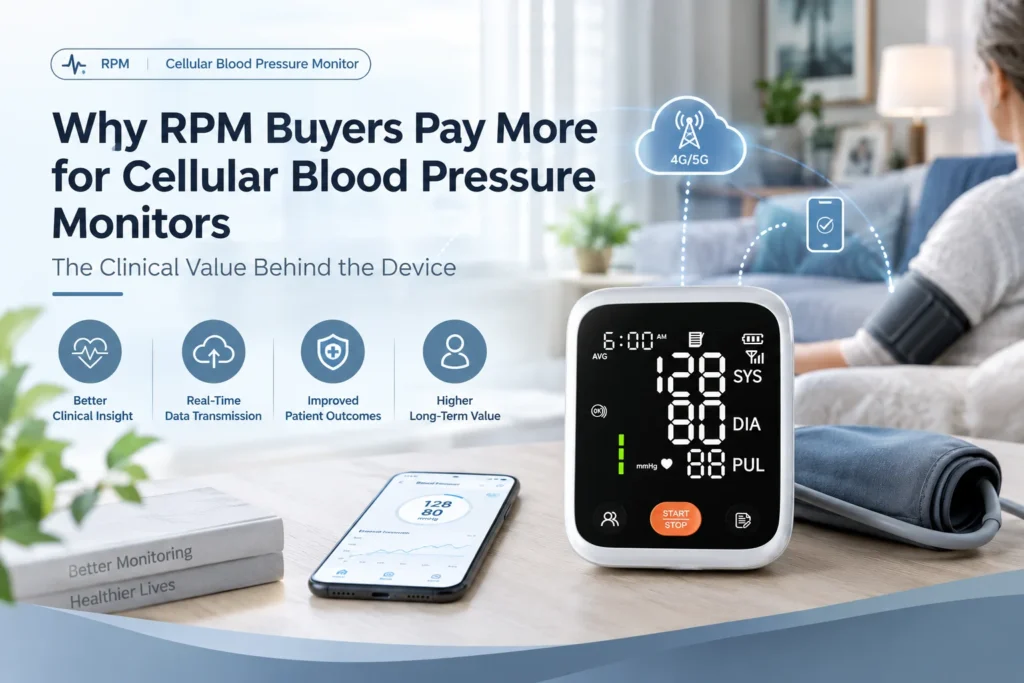

CHF hospitalizations down 67%. Cardiac readmissions down 53%. Blood pressure goal attainment up 70%.
These results are difficult to ignore. However, as Remote Patient Monitoring (RPM) continues to mature, the key question is changing.
The question is no longer simply whether RPM can work. The harder question is whether healthcare organizations can make RPM work consistently in real-world clinical settings.
A 406-patient CHF pilot reported 67% fewer hospitalizations and a 52% reduction in readmissions among patients using RPM. Similarly, a virtual cardiology program published in BMJ Innovations reported a 53% reduction in cardiac readmissions.
Meanwhile, a hypertension program involving more than 23,000 patients and published in JACC: Advances reported a 70% relative increase in patients achieving their blood pressure goals.
Taken together, these findings strengthen the clinical case for RPM. However, clinical outcomes tell only part of the story.
RPM Success Depends on More Than Clinical Efficacy
Just as importantly, healthcare providers need to examine patient engagement and long-term RPM adherence.
In the large hypertension program, 75% of patients were still taking measurements at six months. However, that figure dropped to 57% after 12 months.
Similarly, another team-based hypertension program found that only about half of referred patients ultimately enrolled in the RPM program.
More recently, a 2026 study involving 835 RPM patients found that highly engaged patients had 83% greater odds of achieving blood pressure control.
This finding is particularly important.
Patient engagement is not a secondary RPM metric. It is part of the clinical intervention itself.
A blood pressure monitor sitting unused in a patient’s kitchen provides no meaningful clinical value. Likewise, a connected scale that has not transmitted data for three weeks cannot support effective remote care.
Therefore, the real challenge begins after a physician decides to enroll a patient in RPM.
The Real RPM Challenge Starts After Physician Enrollment
Once a physician orders remote monitoring, the patient still needs to complete several steps.
First, the patient must enroll in the program. Next, they need to receive and activate the connected device. They also need to understand how and when to take measurements.
More importantly, they must continue using the device consistently for weeks or months.
At the same time, someone needs to identify when patient engagement begins to decline.
When incoming RPM data reveals a clinically meaningful change, that information must also reach the appropriate care team quickly enough to support a clinical decision.
As a result, successful RPM requires much more than connected medical devices.
It requires an integrated workflow connecting patient enrollment, device activation, data transmission, clinical review, escalation, and intervention.
RPM Is Entering a New Phase
This is where the RPM market appears to be entering a new stage.
For years, many RPM companies competed primarily on devices, connectivity, software platforms, and dashboards. These capabilities remain important.
However, they are increasingly becoming table stakes.
The larger opportunity now lies in everything that happens between a physician deciding to monitor a patient and that patient ultimately achieving a better clinical outcome.
In other words, the complete RPM experience matters.
Enrollment, activation, sustained engagement, clinical workflow, escalation, documentation, and outcomes are all parts of the same RPM solution.
Yet today, this process remains surprisingly fragmented across many healthcare organizations.
RPM Economics Depend on Workflow Efficiency
The financial side of RPM reinforces the same point.
One hypertension RPM program generated a positive average return on investment at 55% patient compliance. However, depending on operating costs, the return ranged from negative ROI to more than 90%.
Interestingly, the largest cost driver was not the blood pressure monitor itself.
Instead, the human effort required to review and manage patient data represented a major operational cost.
This distinction is critical for RPM companies and healthcare organizations.
The opportunity is not simply to collect more patient data. Rather, the goal is to reduce the cost and operational friction required to turn remote patient data into meaningful clinical action.
Where RPM Companies Can Create More Value
For example, an effective RPM solution could make patient enrollment nearly invisible to physicians.
It could also activate the patient before they leave the clinic. Furthermore, automated engagement monitoring could identify patients who stop transmitting data before they completely disengage from the program.
At the same time, automated workflows could handle routine data review. This would allow clinical teams to focus their time on patients who actually require intervention.
Instead of creating another standalone dashboard, RPM platforms can also deliver actionable information directly into existing clinical workflows.
Ultimately, these improvements can help healthcare organizations move from data collection to data-driven care delivery.
More importantly, RPM providers increasingly need to demonstrate measurable economic value.
That means connecting remote monitoring with outcomes such as:
- Better chronic disease control
- Fewer avoidable hospitalizations
- Reduced readmissions
- Earlier clinical intervention
- Lower care-management costs
- Improved total cost of care
The RPM Reimbursement Landscape Is Also Evolving
The reimbursement environment is moving in the same direction.
In 2026, new RPM codes expanded reimbursement opportunities around shorter monitoring periods and shorter management intervals. At the same time, CMS is paying increasing attention to how remote monitoring services are staffed and delivered.
Consequently, building a sustainable RPM business around reimbursement codes alone is becoming more difficult.
Healthcare organizations must instead consider the complete operational model behind RPM.
The same principle applies to connected medical devices.
There will always be opportunities to develop more accurate, reliable, and user-friendly RPM devices. However, another connected blood pressure monitor alone is unlikely to become the defining competitive advantage.
The more significant opportunity lies in owning the operational layer between the physician’s decision and the patient’s outcome.
The Future RPM Workflow
A successful RPM program increasingly needs to connect the following steps:
Physician Order → Patient Enrollment → Device Activation → Sustained Engagement → Clinical Action → Measurable Outcome
Each stage affects the next.
For example, poor enrollment can reduce activation rates. Difficult device setup can reduce engagement. Declining engagement can reduce the amount of usable clinical data.
Likewise, excessive manual data review can increase operating costs. Finally, slow clinical escalation can limit the potential impact of timely RPM insights.
Therefore, optimizing the entire patient journey is essential.
From RPM Device Vendor to Chronic Care Infrastructure
If an RPM company can reliably move patients through this complete workflow, its role becomes much broader.
It is no longer simply a medical device supplier, connected health platform, or RPM software provider.
Instead, it becomes part of the infrastructure through which chronic care is delivered.
That is certainly a harder problem to solve.
However, it also represents a much larger opportunity.
RPM has spent the past several years demonstrating that remote care can produce meaningful clinical results.
The next phase is about making those results repeatable at scale.
That means supporting real-world patients, existing clinical workflows, limited staffing resources, and the operational realities of modern healthcare.
Ultimately, the strongest RPM solutions will not simply generate more patient data.
They will help healthcare organizations turn that data into sustained engagement, timely clinical action, measurable outcomes, and better economics.
The Key Question for RPM Leaders
So, rather than asking only whether RPM works, healthcare organizations should ask a more practical question:
What percentage of patients referred to your RPM program actually reach sustained engagement and measurable clinical improvement?
That percentage may ultimately tell us more about the real-world value of RPM than any individual device specification or dashboard feature.