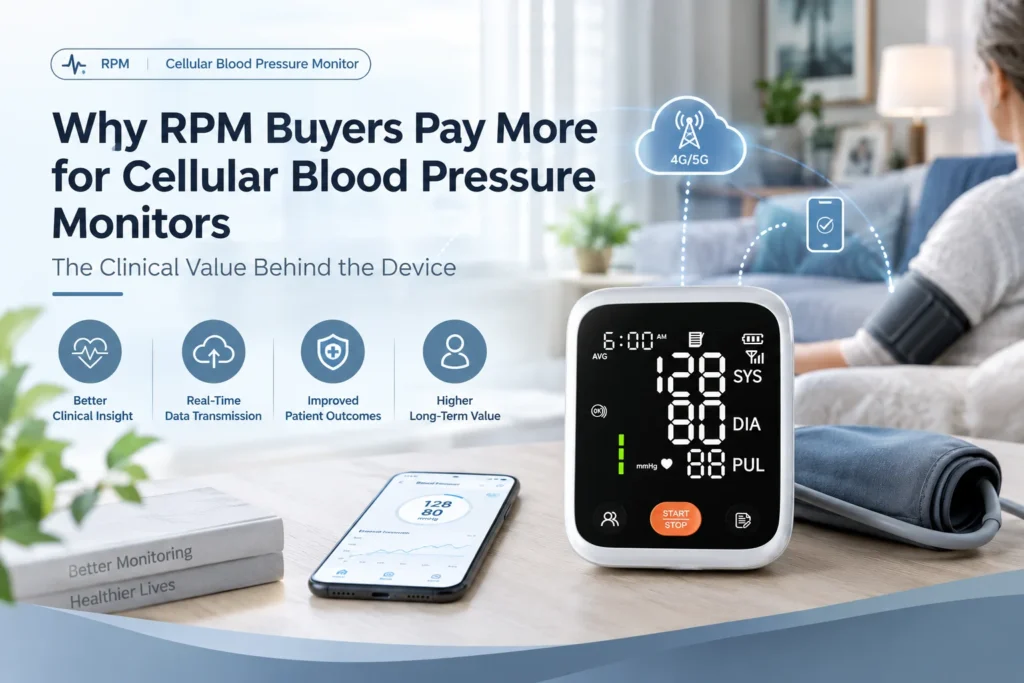

Cardiologists, healthcare administrators, and Remote Patient Monitoring (RPM) program directors face a major clinical transition following the latest updates in hypertension management: “How do modern cardiovascular clinical guidelines reposition remote patient monitoring, and why have home blood pressure readings evolved from a supplementary tool to an essential foundation for treatment decisions?”
With clinical trial data driving blood pressure targets lower, relying on occasional in-office cuff readings often leads to missed diagnoses of white-coat hypertension or masked hypertension. Achieving tighter blood pressure control requires continuous, real-world data collection.
Deploying cellular-connected remote patient monitoring blood pressure devices bridges the gap between clinical appointments, equipping care teams with the longitudinal data needed to adjust medications safely. This guide examines updated guideline targets, clinical trial evidence, data security frameworks, and hardware deployment strategies for modern hypertension programs.
1. Guideline Shifts: Why Tighter Control Targets Require Continuous RPM Data
Recent clinical evidence increasingly supports intensive blood pressure (BP) management for reducing long-term cardiovascular risk. In particular, lower systolic blood pressure targets may help decrease major adverse cardiovascular events (MACE) in appropriately selected patients.
Clinical Evidence for Intensive Blood Pressure Management
| Clinical Study | Patient / Treatment Focus | Key Outcome | Cardiovascular Impact |
|---|---|---|---|
| SPRINT Trial | Intensive systolic BP target below 120 mmHg | Compared with a standard target below 140 mmHg, intensive treatment reduced cardiovascular event risk. | Approximately 25% lower cardiovascular event risk |
| STEP Trial | Older adults with hypertension | A systolic BP target below 130 mmHg was associated with a lower risk of stroke. | Approximately 22% lower stroke risk |
What These Findings Mean for BP Management
The SPRINT trial provides important evidence for intensive systolic BP control. Compared with standard treatment targets, a systolic target below 120 mmHg reduced cardiovascular event risk by approximately 25%.
Similarly, the STEP trial evaluated intensive BP treatment in older adults with hypertension. The study found that targeting systolic BP below 130 mmHg reduced stroke risk by approximately 22%.
Therefore, these findings highlight the potential value of closer blood pressure monitoring and individualized treatment targets. However, intensive BP lowering may not suit every patient. Clinicians should consider age, comorbidities, treatment tolerance, and overall cardiovascular risk when setting BP targets.
For remote patient monitoring (RPM) programs, these findings also reinforce the importance of reliable home BP measurements. Regular readings can help healthcare teams identify changes in blood pressure trends and support timely clinical intervention.
From Office Spot-Checks to Longitudinal Datasets
Intensive blood pressure goals leave little margin for measurement error. In-office readings often suffer from patient anxiety, poor resting technique, or white-coat effects. Implementing a remote patient monitoring blood pressure workflow captures dozens of home readings under natural living conditions, delivering a clear longitudinal trajectory that reflects true cardiovascular risk.
2. Overcoming Tech Barriers: Cellular Transmission vs. Bluetooth Pairing
A major challenge in remote patient monitoring (RPM) is maintaining patient compliance. This issue becomes more significant among older adults who may have difficulty using mobile apps, pairing Bluetooth devices, or connecting to home Wi-Fi networks.
Therefore, connectivity design plays an important role in reducing technical barriers. Compared with traditional Bluetooth setups, an integrated 4G cellular device can simplify patient onboarding and support more reliable data transmission.
Integrated 4G Cellular vs. Traditional Bluetooth Connectivity
| Deployment Factor | Integrated 4G Cellular | Traditional Bluetooth (BLE) |
|---|---|---|
| Out-of-Box Setup | Works with minimal setup and supports plug-and-play deployment | Requires smartphone app installation and Bluetooth pairing |
| Technical Complexity | Simple, often supporting one-button operation | More steps may be required for pairing and troubleshooting |
| Data Transmission | Sends encrypted data directly through the cellular network | Depends on the patient’s smartphone and internet connection |
| Connectivity Reliability | Less dependent on home Wi-Fi or smartphone availability | Bluetooth or smartphone connection may be interrupted |
| Patient Experience | Easier for seniors and patients with limited technical skills | Better suited to patients who are comfortable using mobile apps |
| Recommended Use | Elderly patients, rural populations, and large-scale RPM programs | Tech-savvy patients and app-based remote care programs |
As a result, 4G cellular connectivity can reduce patient-side technical friction and simplify RPM deployment. In addition, healthcare providers can avoid relying on a patient’s personal smartphone or home Wi-Fi network.
For elderly patients and users in rural or underserved areas, this approach can improve device accessibility and support more consistent remote health data collection. Consequently, healthcare organizations can streamline patient onboarding while reducing connectivity-related support requirements.
3. Hardware Profile: The RPMCore ARM-90B Lite
At RPM, we supply medical-grade hardware engineered specifically for seamless clinical deployment and long-term patient compliance. Manufactured in partnership with AOJ Medical, the RPMCore ARM-90B Lite provides the reliable hardware foundation necessary for high-performing hypertension monitoring programs:
FDA-Cleared Diagnostic Accuracy: Fully FDA-cleared, meeting rigorous clinical testing standards for systolic, diastolic, and pulse measurements required in professional diagnostic environments.
Instant Out-of-the-Box 4G Cellular Connectivity: Features an integrated 4G module that transmits readings automatically over encrypted cellular networks immediately after measurement—requiring no Wi-Fi, smartphones, or complex Bluetooth pairing.
HIPAA-Compliant Encrypted Data Integrity: Built-in encryption protocols safeguard patient health information (PHI) during real-time data transmission directly to your clinical platform.
Designed for High Senior Compliance: Engineered with a single-button interface and a large, high-contrast display, removing technical hurdles to boost daily patient adherence rates.
4. Strategic Implementation Framework for Healthcare Organizations
Clinical teams launching or expanding a remote patient monitoring blood pressure program can streamline patient onboarding through a four-stage process:
Patient Identification & Stratification: Identify patients diagnosed with uncontrolled Stage 1 or Stage 2 hypertension, masked hypertension, or high cardiovascular risk profiles using electronic health record (EHR) data.
Frictionless Device Distribution: Ship pre-configured 4G cellular monitors directly to patients’ homes. Out-of-the-box connectivity eliminates technical support calls for smartphone app pairing.
Automated EHR Data Ingestion: Integrate incoming encrypted cellular telemetry streams directly into EHR dashboards, enabling nurses to review real-time trends without manual entry.
Targeted Medication Titration: Use aggregated home blood pressure averages to guide timely medication adjustments, accelerating time-to-target while lowering stroke and infarction risks.
Technical Summary
Updated clinical guidelines underscore the importance of intensive blood pressure control, making out-of-office data collection an essential component of modern cardiology workflows. Utilizing an FDA-cleared, cellular-connected remote patient monitoring blood pressure device allows healthcare providers to gather reliable, real-world readings without placing technical burdens on patients. By eliminating connectivity friction, clinical teams can improve patient engagement, make timely treatment adjustments, and deliver better long-term cardiovascular outcomes. RPM supplies medical-grade cellular devices, encrypted hardware infrastructure, and remote monitoring tools for healthcare organizations worldwide.