
Remote Patient Monitoring (RPM) programs encounter a recurring operational question from healthcare providers: “Can simplified cellular blood pressure monitors truly overcome cognitive and technical barriers in patients aged 70+, and is there empirical evidence supporting one-button usability?”
While connected care models improve chronic disease outcomes, non-compliance remains a primary failure point. The Merck Manual notes that only about half of chronic care patients adhere to long-term treatment regimens or equipment protocols, citing memory loss, technical complexity, and lack of home internet as major hurdles for older demographics.
This clinical overview examines real-world usability data from elderly cohorts, analyzes the operational impact of cellular connectivity, and demonstrates how simplified hardware bridges the digital divide for 4G cellular blood pressure monitor deployments.
1. Real-World Usability Evidence in Elderly Patient Cohorts
Real-world usability is crucial when healthcare providers deploy remote patient monitoring (RPM) systems for older adults. In particular, device simplicity can directly influence daily engagement and data transmission.
A six-month real-world study published in a 2025 Oxford Academic journal evaluated RPM kit usage among 72 patients. The participants had a mean age of 71 ± 8 years and managed both heart failure and diabetes.
Elderly RPM Usability Study Results
| Evaluation Parameter | Observed Results |
|---|---|
| Patient Cohort | 72 patients |
| Mean Patient Age | 71 ± 8 years |
| Active App Engagement | 70 patients (97%) successfully operated the monitoring system |
| Total Logged Interactions | 4,915 interactions |
| Average Interactions | 159 ± 113 interactions per patient |
| Excellent SUS Rating | 25% of patients |
| Good SUS Rating | 10% of patients |
| Sufficient SUS Rating | 38% of patients |
| Poor SUS Rating | 17% of patients |
Core Insight: Simple RPM Devices Can Improve Patient Engagement
The study shows that device usability plays an important role in RPM compliance. Although older adults may experience technical barriers, engagement can remain high when monitoring devices minimize complicated setup procedures.
Importantly, 73% of elderly patients rated their RPM systems as sufficient, good, or excellent. This result suggests that straightforward device operation can support consistent participation in remote care programs.
In addition, approximately 20% of the highest-performing patients received assistance from family caregivers. Therefore, reducing device setup requirements can also make caregiver support easier.
For healthcare providers, this finding highlights an important procurement consideration. An elderly-friendly RPM device should minimize pairing, configuration, and daily operation steps. As a result, patients and caregivers can complete routine measurements with less technical support.
Ultimately, simple onboarding and automated data transmission can improve RPM usability among elderly patients. For healthcare systems managing chronic conditions, these features can support higher engagement and more consistent remote monitoring.
2. 4G Cellular vs. Bluetooth: Removing Setup Barriers in Senior Care
Comparing communication protocols highlights why cellular devices outperform Bluetooth alternatives in elderly RPM programs:
| Engineering Parameter | Bluetooth (BLE) Blood Pressure Cuffs | 4G Cellular Blood Pressure Monitor |
| Initial Configuration | Requires smartphone app pairing & Wi-Fi setup | Out-of-the-box (Zero pairing required) |
| Data Transmission Path | Dependent on patient’s smartphone/home Wi-Fi | Direct encrypted cellular data uplink |
| Patient Workflow | Multi-step: Open app, sync, confirm upload | Single action: Wrap cuff & press start |
| Caregiver Burden | High (Troubleshooting lost Bluetooth links) | Minimal (Passive background transmission) |
3. Device Engineering: RPMCore ARM-90B Lite
The RPMCore ARM-90B Lite by AOJ Medical addresses technical friction in senior populations through simplified hardware:
FDA-Cleared Diagnostic Accuracy: Fully cleared by the FDA to meet stringent clinical standards for blood pressure and pulse rate measurement, providing reliable data for professional care decisions.
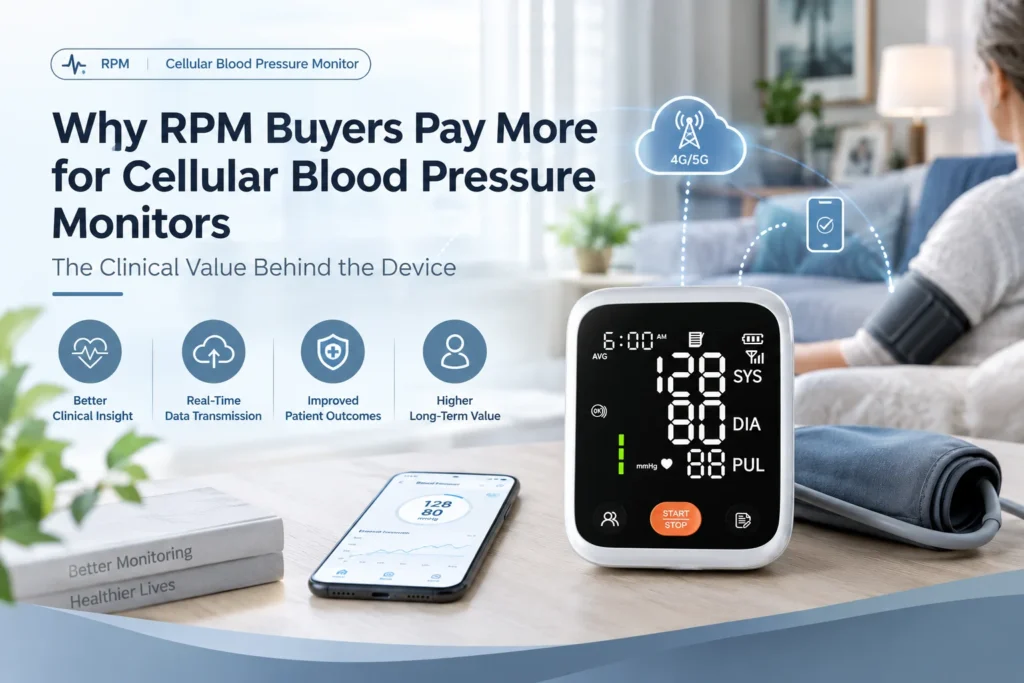
Instant 4G Cellular Connectivity: Features a built-in 4G module that transmits readings out-of-the-box via cellular networks, eliminating smartphone pairing or home Wi-Fi configurations.
Encrypted Data Integrity: Transmits every reading across secure, encrypted channels to maintain full HIPAA and data protection compliance during real-time syncing.
Single-Button Senior Interface: Designed with a large, high-contrast LCD and a single-button start/stop interface, removing technical barriers to increase daily compliance.
4. Strategic RPM Implementation Guide for Healthcare Organizations
To maximize patient compliance and data collection across chronic care management programs, clinical administrators should apply three key operational steps:
Deploy Out-of-the-Box Hardware: Utilize a 4G cellular blood pressure monitor to bypass home internet setups, ensuring reliable data collection for low-income or rural senior patients.
Simplify the Measurement Protocol: Select single-button devices that require no manual app logging, allowing patients to complete daily readings in under 60 seconds.
Enable Caregiver Support: Provide family members with access to patient portals, enabling them to assist elderly relatives without managing complex device configurations.
Technical Summary
Clinical evidence confirms that elderly patients aged 70+ can maintain high engagement in remote care programs when equipment removes technical obstacles. Utilizing a single-button 4G cellular blood pressure monitor eliminates smartphone pairing, home Wi-Fi requirements, and manual data logging. The RPMCore ARM-90B Lite provides FDA-cleared accuracy, secure encrypted cellular transmission, and a simplified senior interface to support chronic care compliance. AOJ Medical supplies professional connected health hardware, cellular medical devices, and RPM monitoring solutions for healthcare organizations globally.