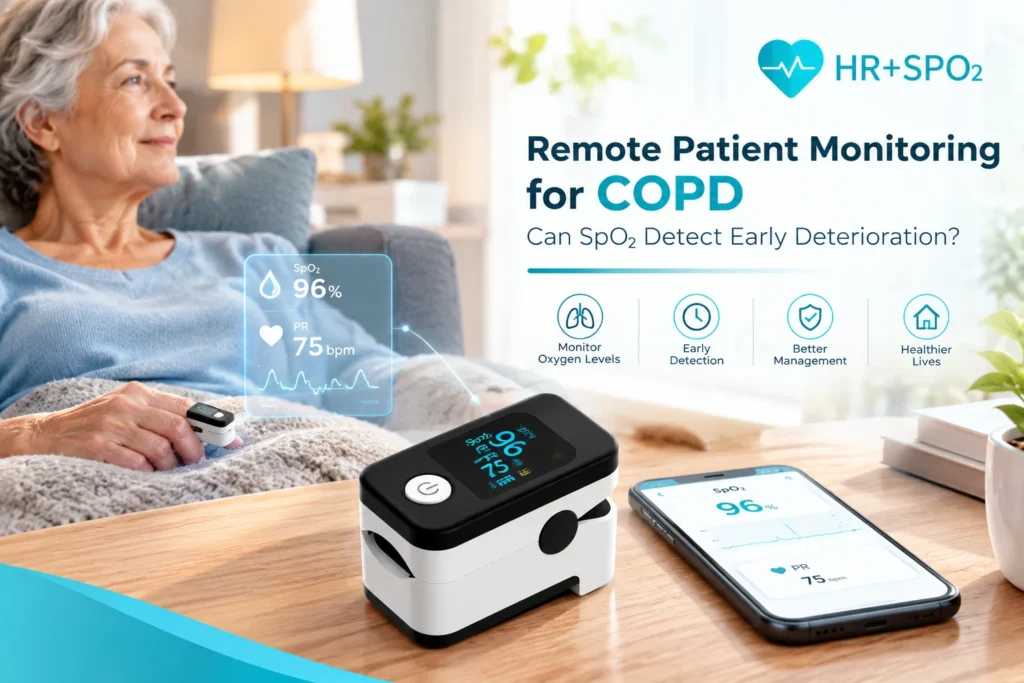

A pulse oximeter for remote patient monitoring traditionally focuses on two vital parameters: oxygen saturation (SpO2) and pulse rate (PR). But for patients with chronic respiratory and cardiovascular conditions, respiratory rate (RR) can add another important layer of physiological information.
This matters particularly in COPD and heart failure RPM programs. Changes in respiratory rate may occur before a clear fall in SpO2 in some patients, creating an additional trend that care teams can evaluate alongside symptoms, oxygen saturation, and pulse rate. A home study of COPD patients found that respiratory frequency increased during the days preceding hospitalization for acute exacerbations.
For RPM program managers, the question is therefore not simply whether a device can measure SpO2. It is whether a remote patient monitoring pulse oximeter can collect multiple relevant vital signs reliably, transmit them efficiently, and fit into a workflow that patients can actually follow.
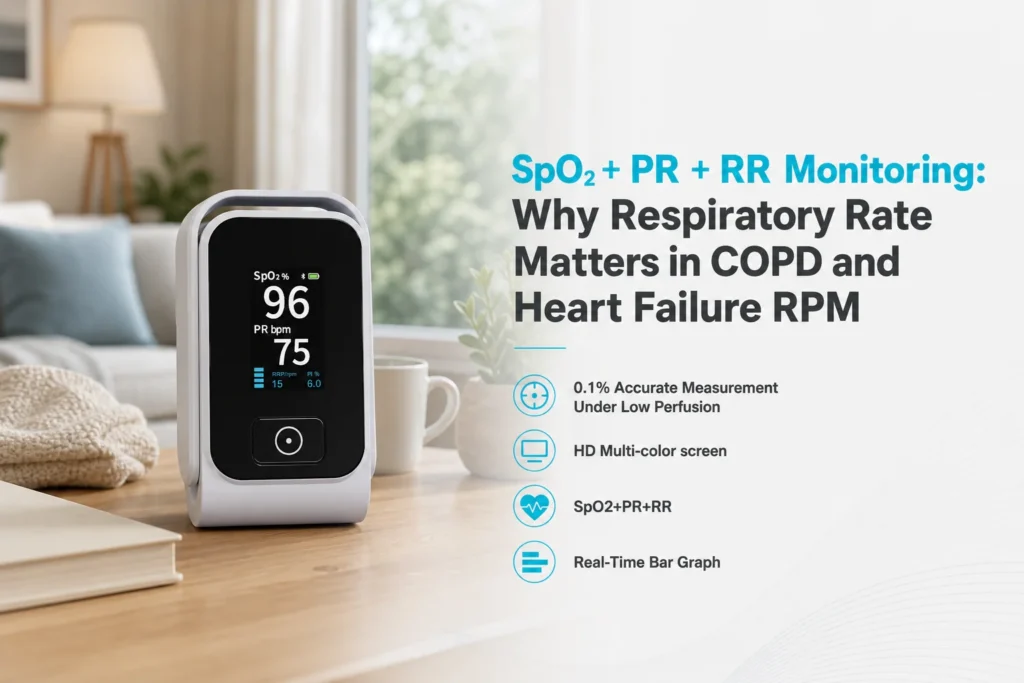
The AOJ RPMCore Oxi-70H Pro combines SpO2, Pulse Rate, and Respiratory Rate in a single reading, with built-in 4G cellular connectivity for direct data transmission.
Why Respiratory Rate Adds Value to Pulse Oximeter Data
SpO2 tells clinicians about oxygen saturation at the time of measurement. Pulse rate provides another cardiovascular signal. Respiratory rate adds information about the patient’s breathing pattern.
These measurements answer different questions.
| Parameter | What It Measures | Potential RPM Value |
|---|---|---|
| SpO2 | Blood oxygen saturation | Identifies oxygenation changes |
| PR | Pulse rate | Provides cardiovascular trend information |
| RR | Breaths per minute | Adds information about respiratory status |
| Combined trend | Changes across multiple parameters | Provides broader physiological context |
A single abnormal reading does not necessarily indicate clinical deterioration. However, repeated measurements and changes from a patient’s baseline can provide additional information for clinical review.
Research in COPD has shown that respiratory frequency can rise before an acute exacerbation requiring hospitalization. In one study of 89 patients receiving domiciliary oxygen, 70% of those hospitalized for COPD exacerbation showed an increase in respiratory frequency during the five days before hospitalization.
This supports the clinical rationale for including RR in a broader home-monitoring dataset.
Q: Can Respiratory Rate Change Before SpO2 Falls?
RR Can Provide a Different Physiological Signal
Respiratory rate and oxygen saturation do not necessarily change at the same time.
During a COPD exacerbation, increased respiratory effort can occur while oxygen saturation remains relatively stable, depending on disease severity, supplemental oxygen use, baseline physiology, and other factors.
A study using home respiratory-frequency monitoring found that a mean respiratory-frequency increase of 4.4 breaths/min, or approximately 30% from baseline, 24 hours before hospitalization provided 66% sensitivity and 93% specificity in that study population. Two days before hospitalization, a 2.3 breaths/min increase, or approximately 15% from baseline, provided 72% sensitivity and 77% specificity.
These findings should not be interpreted as a universal clinical threshold. Instead, they illustrate why respiratory rate trends can complement SpO2 monitoring.
Why Baseline Trends Matter
For RPM teams, the most useful question may not be:
“Is this patient’s RR above a fixed number?”
Instead, the workflow may ask:
“Has this patient’s RR changed meaningfully from their established baseline?”
This distinction is important because respiratory rate varies with age, activity, anxiety, medication, disease status, and measurement conditions.
A multi-parameter dataset can therefore give clinicians more context than a single isolated SpO2 value.
Q: What Does RPM Research Show for COPD and Heart Failure?
COPD: Respiratory Rate Can Support Early Trend Detection
COPD is associated with substantial post-discharge readmission risk. Historical U.S. Medicare data reported that 22.6% of beneficiaries hospitalized for COPD were readmitted within 30 days; more recent studies report varying rates depending on population and definition.
This makes the post-discharge period an important target for remote monitoring.
Importantly, RPM should not be viewed as a replacement for clinical assessment. Instead, home measurements can provide additional longitudinal data between scheduled encounters.
Research has found that SpO2, pulse rate, and respiratory rate can all contribute to COPD exacerbation prediction, with the combination providing more information than relying on one vital sign alone.
Heart Failure: Respiratory Data Can Add Context
Respiratory changes are also relevant in heart failure monitoring.
Studies of home and wearable monitoring have examined respiratory rate alongside heart rate, activity, temperature, thoracic impedance, and other physiological signals for detecting impending heart failure deterioration.
This does not mean that RR alone can diagnose heart failure decompensation. Rather, it can become one component of a multiparameter monitoring strategy.
For RPM program designers, this distinction is important: the value of RR is often in combination with other clinical data and trends rather than as a standalone diagnostic measurement.
Q: What Accuracy Standard Should RPM Teams Look for in Respiratory Rate Monitoring?
Start With the Intended Use of the Device
There is no single universal “RR accuracy number” that automatically establishes whether every respiratory-rate measurement device is suitable for every RPM application.
For a pulse oximeter, buyers should first verify the device’s intended use, regulatory status, measurement method, validation data, and labeling.
The current ISO 80601-2-61:2026 standard addresses the basic safety and essential performance of pulse oximeter equipment, including equipment intended for professional and home healthcare environments.
For manufacturers and purchasers evaluating SpO2 and PR performance, FDA guidance also recommends testing approaches based on the applicable pulse-oximeter standard, including testing for SpO2 and pulse-rate accuracy and consideration of conditions such as motion and low perfusion when relevant to device claims.
Evaluate RR as a Separate Performance Claim
Because RR is an additional measurement, RPM buyers should ask the manufacturer for specific information about:
- RR measurement methodology
- Validated measurement range
- Accuracy or agreement data
- Testing population
- Measurement conditions
- Motion limitations
- Low-perfusion performance where relevant
- Repeatability
- Data transmission reliability
- Regulatory documentation
This is more useful than simply asking whether a pulse oximeter “supports RR.”
For clinical procurement, the device’s actual validation evidence should determine whether its RR measurement is appropriate for the intended workflow.
Q: Is a Three-Parameter Pulse Oximeter More Cost-Effective Than Multiple Devices?
Compare the Entire RPM Workflow
A simple unit-price comparison can be misleading.
A conventional pulse oximeter may provide SpO2 and PR, while a separate device or sensor may be needed to capture another physiological parameter. A three-parameter device can consolidate data collection into a single patient interaction.
For an RPM program, the comparison should therefore include:
| Cost / Workflow Factor | Multiple Devices | SpO2 + PR + RR Device |
|---|---|---|
| Patient devices | Multiple | One device |
| Measurement steps | More | Fewer |
| Patient training | Potentially higher | Simpler |
| Data sources | Multiple | Consolidated |
| Device logistics | More complex | Simplified |
| Connectivity management | Potentially multiple | Can be centralized |
| Data interpretation | Multiple streams | Combined vital-sign dataset |
The actual economic outcome depends on device pricing, patient volume, connectivity model, staffing, platform integration, reimbursement structure, and clinical workflow.
Therefore, a three-in-one device should not automatically be described as “cheaper.” Its potential advantage is workflow consolidation.
Why 4G Connectivity Matters in Home RPM
Adding more physiological measurements only helps if the data can reach the care team consistently.
Traditional home devices may depend on Wi-Fi, Bluetooth, smartphones, or patient-operated applications. These additional steps can create barriers for some elderly or chronically ill patients.
The Oxi-70H Pro uses an integrated 4G cellular module to transmit measurements directly after the reading.
No Wi-Fi or Smartphone Pairing Required
The device is designed around a plug-and-play workflow:
Patient measures → Oxi-70H Pro captures SpO2 + PR + RR → 4G network transmits data → care team receives the reading
This removes several potential steps from the patient workflow.
For post-discharge patients and elderly users, reducing technical complexity can be particularly relevant to measurement adherence.
How the Oxi-70H Pro Supports Multi-Parameter RPM
The RPMCore Oxi-70H Pro combines three vital measurements in one portable pulse oximeter:
SpO2
Oxygen saturation provides the core oxygenation measurement expected from a pulse oximeter and can be tracked over time as part of a home-monitoring protocol.
Pulse Rate
Pulse rate adds cardiovascular context to oxygen saturation and respiratory measurements.
Respiratory Rate
RR extends the dataset beyond conventional SpO2 and PR monitoring and can help care teams observe changes in respiratory status over time.
The clinical value comes from viewing these measurements together rather than treating any single number as a diagnosis.
Which Patients May Benefit Most From RR Monitoring?
Patients With COPD
Patients with COPD are a natural target population because respiratory-rate changes have been studied as a potential early signal of exacerbation.
This is particularly relevant after discharge, when care teams need longitudinal information between clinical visits.
Patients With Heart Failure and Respiratory Symptoms
Patients with heart failure may experience respiratory changes as their condition deteriorates. Multiparameter monitoring studies have therefore incorporated respiratory data alongside other physiological signals.
Elderly Patients Requiring Simple Home Monitoring
For patients who may have difficulty managing multiple connected devices, consolidating measurements into a single cellular pulse oximeter can simplify the home workflow.
The Oxi-70H Pro uses one-button operation and a bright LED interface, reducing the number of steps required during routine measurement.
What Does This Mean for an RPM Program Manager?
The practical value of RR is not that it replaces SpO2.
It is that SpO2, PR, and RR provide complementary physiological signals.
For example:
SpO2 ↓ + RR ↑ + PR ↑
may provide a different clinical picture from:
SpO2 stable + RR ↑ + PR stable
The appropriate response depends on the patient’s baseline, symptoms, treatment plan, and clinical protocol. The device supplies measurements; the care team determines how those measurements should be interpreted and acted upon.
This makes a multi-parameter pulse oximeter for RPM particularly relevant when a program wants to move beyond isolated oxygen saturation readings toward longitudinal vital-sign monitoring.
How to Evaluate a Pulse Oximeter for RPM Procurement
Before deploying a device across a clinical population, RPM teams should evaluate five areas.
1. Vital Parameters
Confirm whether the device measures the parameters required by the program:
- SpO2
- Pulse Rate
- Respiratory Rate
2. Connectivity
Determine whether the device requires:
- Wi-Fi
- Bluetooth
- Smartphone pairing
- Cellular connectivity
For large-scale home programs, fewer patient-side connection steps can simplify deployment.
3. Measurement Performance
Review the manufacturer’s validation and regulatory documentation rather than relying only on marketing terminology such as “clinical grade.”
4. Patient Usability
Consider:
- Number of operating steps
- Display readability
- Device portability
- Charging requirements
- Patient training
- Elderly-user accessibility
5. Platform Integration
A successful RPM deployment requires more than hardware.
The device should fit the program’s data architecture, including data transmission, API or platform integration where applicable, patient identification, alert workflows, and clinical review processes.
The Bottom Line: RR Complements SpO2 in RPM
For COPD and heart failure RPM, SpO2 remains an important home-monitoring parameter, but it does not provide the complete respiratory picture.
Research indicates that respiratory-rate changes can precede COPD exacerbation hospitalization in some patients, while respiratory data are also being investigated as part of multiparameter approaches to heart failure deterioration.
The practical advantage of a SpO2 + PR + RR pulse oximeter is therefore not simply “more numbers.” It is the ability to collect complementary vital signs through one patient interaction.
The Oxi-70H Pro combines these three parameters with 4G cellular connectivity, one-button operation, and direct data transmission, making it designed for home monitoring, post-discharge follow-up, COPD and heart failure RPM workflows, and decentralized clinical data collection.
For RPM teams evaluating a new cellular pulse oximeter, the key procurement question is not only “How accurate is the SpO2?” but also:
Can the device reliably collect the vital signs the program needs, transmit them with minimal patient effort, and integrate those measurements into an actionable clinical workflow?