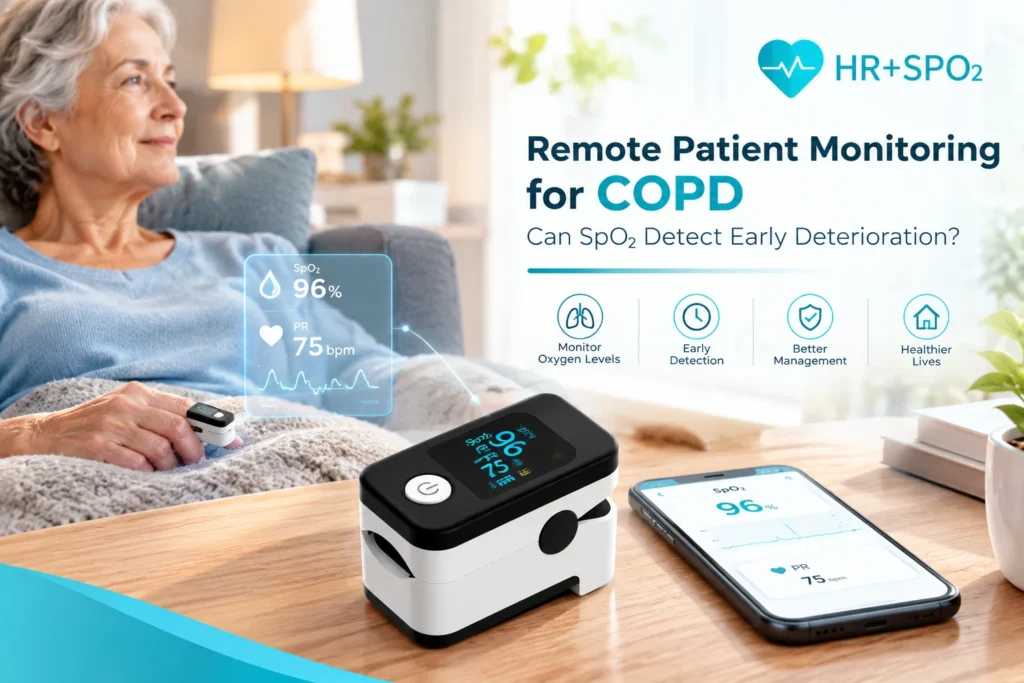

For clinical teams managing patients with chronic obstructive pulmonary disease (COPD), the value of remote patient monitoring for COPD is not simply collecting more SpO₂ readings. The real question is whether a change in oxygen saturation can provide a clinically useful signal before a patient experiences obvious deterioration.
Current evidence suggests that remote SpO₂ monitoring can help identify physiological changes associated with COPD exacerbation in some patients, but the timing is not universal. In one home telemonitoring pilot study, an SpO₂ alert below 88% occurred approximately 48 hours before one reported exacerbation. However, the other four exacerbation events in the study did not show clear preceding physiological alarms.
This distinction matters. Remote pulse oximetry can provide an earlier data point, but data only becomes clinically valuable when providers define what constitutes a meaningful change, who reviews the alert, and what action follows.
How Can Remote SpO2 Monitoring Help With COPD?
COPD exacerbations can involve changes in respiratory symptoms and physiological measurements before patients seek medical attention. Remote monitoring allows clinical teams to observe these measurements outside the traditional clinic visit.
A COPD remote monitoring program may track:
- SpO₂
- Pulse rate
- Respiratory rate
- Symptoms
- Activity or functional status
- Spirometry or other pulmonary measurements
Pulse oximetry is particularly practical because it is non-invasive and relatively simple for patients to use at home.
However, SpO₂ should be interpreted as one component of a broader clinical picture, rather than an independent diagnosis of an exacerbation.
Can SpO2 Fall Before Patients Notice Severe Symptoms?
It can, but the timing varies between patients and episodes.
A pilot home telemonitoring study documented one exacerbation in which an SpO₂ value below 88% and declines in pulmonary function occurred 48 hours before the patient reported the COPD exacerbation. The same study also showed why clinicians should avoid treating this interval as a guaranteed prediction window: four other exacerbations did not have comparable physiological alarms beforehand.
This means the clinically useful concept is not:
“SpO₂ always predicts an exacerbation 24–48 hours in advance.”
A more defensible interpretation is:
“A sustained or clinically meaningful change in SpO₂ may provide an earlier warning signal in some patients, creating an opportunity for assessment and intervention.”
That distinction is important when designing a professional COPD RPM program.
How Much SpO2 Decline Should Trigger an Intervention?
There is no single SpO₂ decline that can safely serve as a universal intervention threshold for every COPD patient.
A patient’s baseline saturation, oxygen prescription, disease severity, comorbidities, and usual response to activity all matter.
Avoid Using a Single Number in Isolation
For example, an isolated lower SpO₂ reading may result from:
- Poor sensor placement
- Cold extremities
- Motion
- Temporary physiological variation
- Measurement artifact
- Changes in oxygen use
- Activity immediately before measurement
A clinical protocol should therefore distinguish between an isolated reading and a persistent or repeated deviation from the patient’s expected range.
Consider the Patient’s Baseline
Instead of relying exclusively on a population-wide threshold, providers can establish an individualized baseline during a clinically stable period.
The monitoring system can then evaluate:
Current SpO₂ → Patient baseline → Direction of change → Persistence → Symptoms → Clinical action
This approach is more informative than treating every patient with the same numerical threshold.
What SpO2 Thresholds Are Relevant in COPD?
Thresholds should be defined by the treating clinical team according to the patient’s condition and treatment plan.
In acute COPD exacerbation management, controlled oxygen therapy commonly targets an SpO₂ range of 88–92% for patients at risk of hypercapnic respiratory failure, rather than simply maximizing oxygen saturation.
This is an important reason why an RPM device should not independently instruct patients to increase oxygen flow or change treatment based on an automated alert.
A remote monitoring alert should prompt an appropriate clinical assessment according to the provider’s protocol.
Can Remote Monitoring Replace Pulmonary Function Testing?
No. Remote SpO₂ monitoring and pulmonary function testing serve different purposes.
Pulse oximetry measures peripheral oxygen saturation and pulse rate. It does not measure airflow obstruction or provide the full physiological information obtained through pulmonary function testing.
Pulmonary function testing can provide measurements such as:
- FEV₁
- FVC
- FEV₁/FVC
- Other measures of lung function
Remote pulse oximetry instead provides a convenient way to observe oxygenation trends between clinical encounters.
Remote SpO2 Monitoring Is a Complementary Tool
For COPD management, a connected pulse oximeter can help fill the monitoring gap between clinic visits.
A simplified workflow is:
Clinical assessment → Baseline → Home monitoring → Data transmission → Trend review → Clinical assessment → Intervention when indicated
This makes remote monitoring a complement to conventional COPD assessment, rather than a replacement for spirometry or other diagnostic evaluation.
How Should COPD RPM Alert Thresholds Be Designed?
A useful COPD monitoring protocol should define more than a single SpO₂ number.
1. Define the Patient’s Baseline
The care team should determine the patient’s expected physiological range during a stable period.
This provides context for future measurements.
2. Define a Meaningful Deviation
The protocol can specify what type of change should generate additional review.
Depending on the patient and program, this may involve:
- A threshold below the patient’s prescribed target
- A sustained decline from baseline
- Repeated abnormal measurements
- A combination of SpO₂ and symptom changes
- Changes in multiple physiological parameters
3. Confirm the Measurement
Before escalating an alert, the protocol should account for measurement quality and potential device-related artifacts.
This is particularly important for home monitoring because patients may use the device under different environmental and physical conditions.
4. Combine SpO2 With Symptoms
A declining SpO₂ value becomes more clinically informative when it occurs alongside symptoms such as increasing dyspnea, cough, sputum changes, fatigue, or reduced functional capacity.
Remote monitoring should therefore support clinical context, not replace it.
5. Define the Response
Every alert should have a predetermined workflow.
For example:
Alert → Data review → Patient contact → Clinical assessment → Appropriate intervention or escalation
The exact intervention should be determined by the patient’s care plan and qualified healthcare professionals.
Why the Intervention Protocol Matters More Than the Device Alone
The clinical value of RPM does not come from data collection alone.
Aetna’s current RPM policy states that evidence for COPD is mixed, with benefits varying by population and intervention design. Its review notes that RPM may reduce COPD-related hospital readmissions or emergency visits in some populations, particularly patients with frequent exacerbations, but it has not consistently improved all measured outcomes.
This leads to an important principle:
More physiological data does not automatically mean better COPD care.
The program needs a defined pathway from measurement to clinical decision-making.
A professional RPM program should answer four questions:
What changed?
Is the change clinically meaningful?
Who reviews it?
What happens next?
Without those steps, an alert can become another data point rather than an actionable clinical signal.
What Makes a Connected Pulse Oximeter Useful for COPD RPM?
For remote monitoring, the device needs to fit into the clinical workflow as well as the patient’s home environment.
A connected pulse oximeter can reduce the manual steps required for data collection and transmission.
4G Connectivity Reduces Patient Setup Requirements
The RPMCore 70A Lite is a professional-grade FDA-cleared 4G pulse oximeter designed for the RPM ecosystem.
It captures SpO₂ and pulse rate data and transmits encrypted results through a 4G cellular network.
Importantly, the device does not require:
- Wi-Fi configuration
- Smartphone pairing
- Manual data transfer
This can simplify deployment for patients who may have limited technical experience or inconsistent access to home internet.
Automated Data Transmission Supports Remote Workflows
In a connected RPM model, the objective is to move from:
Patient measures → Patient records → Patient reports → Provider reviews
toward:
Patient measures → Device transmits → Clinical team reviews
Reducing manual transmission steps can make repeated home measurements easier to integrate into a structured monitoring program.
Can Remote SpO2 Monitoring Reduce COPD Emergency Visits?
The evidence is promising in some settings but does not support a universal claim that remote pulse oximetry prevents emergency visits.
A 2023 observational study of 126 people with COPD found that implementation of remote cardiorespiratory monitoring was associated with a lower rate of unplanned hospitalizations compared with the participants’ prior year. However, the study was observational and involved a broader RPM intervention rather than SpO₂ monitoring alone.
Aetna’s review similarly concludes that COPD RPM results vary according to intervention design and patient population.
Therefore, clinical teams should evaluate RPM based on the complete care pathway, not assume that adding a pulse oximeter alone will produce a specific utilization outcome.
FAQ: Remote Patient Monitoring for COPD
How early can SpO2 monitoring detect COPD deterioration?
There is no universal advance-warning period. Some studies have identified physiological changes before clinically recognized exacerbations. In one small home telemonitoring study, an SpO₂ alert below 88% occurred 48 hours before one reported exacerbation, but other exacerbations in the same study did not show comparable early alarms.
Therefore, 24–48 hours should be treated as a possible observation window in some cases, not a guaranteed COPD prediction period.
What SpO2 level requires intervention in COPD?
The appropriate threshold depends on the patient’s clinical condition and treatment plan. For patients at risk of hypercapnic respiratory failure during an acute exacerbation, controlled oxygen therapy commonly targets 88–92%.
For RPM, providers should establish individualized alert rules rather than relying on one universal number.
Can a remote pulse oximeter replace spirometry?
No. SpO₂ monitoring measures oxygen saturation and pulse rate, while spirometry evaluates pulmonary function. Remote pulse oximetry should be used as a complementary monitoring tool rather than a replacement for pulmonary function testing.
Should an RPM alert automatically change a patient’s oxygen therapy?
Not by itself. An automated alert should trigger the clinical workflow defined by the care team. Oxygen therapy and other treatment changes should follow the patient’s prescribed care plan and professional clinical assessment.
What makes a 4G pulse oximeter suitable for COPD RPM?
A 4G-connected pulse oximeter can transmit SpO₂ and pulse-rate data without requiring patients to configure Wi-Fi or pair a smartphone. For programs serving patients with different levels of digital literacy or inconsistent home internet access, reducing setup requirements can simplify deployment.
From SpO2 Data to Clinical Value
The real value of remote patient monitoring for COPD is not the number of measurements collected. It is the ability to identify meaningful changes, place them in the context of symptoms and patient baseline, and connect them to a timely clinical response.
Remote SpO₂ monitoring may provide an early physiological signal in some COPD patients, potentially creating an opportunity for earlier assessment. However, current evidence does not support treating a 24–48-hour warning window as universal, and RPM outcomes remain dependent on patient selection and intervention design.
For clinical teams, the practical model is therefore:
Measure → Transmit → Detect → Assess → Intervene
The device supplies the data. The clinical protocol turns that data into care.
For RPM programs that require connected home SpO₂ and pulse-rate monitoring, the RPMCore 70A Lite combines an FDA-cleared 4G pulse oximeter with encrypted cellular data transmission, without requiring Wi-Fi or smartphone pairing.