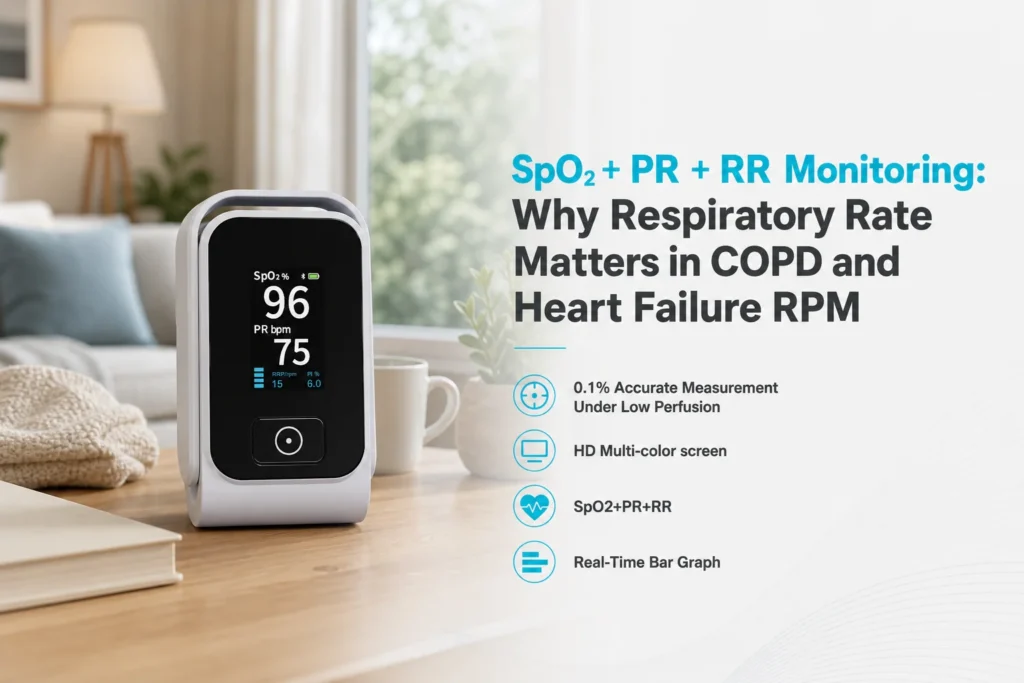

In modern remote patient management (RPM) and Hospital-at-Home models, monitoring vital signs accurately and continuously is critical for preventing clinical deterioration. Traditional spot-check protocol—measuring body temperature manually every 4 to 6 hours—leaves significant monitoring blind spots. Clinical data demonstrate that intermittent fever spikes and nighttime temperature fluctuations are frequently missed during these unmonitored intervals.
Deploying a continuous remote patient management thermometer solution enables clinical teams to transition from reactive spot-checks to proactive, real-time monitoring. By capturing full-spectrum thermal trends, integrated RPM thermometer devices dramatically increase fever detection rates and provide actionable data for early clinical intervention.
1. Clinical Validation: Continuous Monitoring vs. Traditional Spot-Checks
Findings from a clinical validation study involving 208 Hospital-at-Home patients using the Viture® continuous temperature monitoring system highlight the operational limitations of traditional spot-checks:
| Operational & Clinical Metric | Traditional Spot-Check Protocol (Every 4–6 Hours) | Continuous RPM Temperature Monitoring System |
| Fever Detection Efficacy | High risk of missing short-duration or overnight spikes | 3x Higher Fever Detection Rate (Captures intermittent events) |
| Time to Detection Lead | Delayed until next scheduled manual measurement | Detected 7.23 Hours Earlier on average |
| Impact on Treatment Plans | Delayed response to infection or inflammation | 43.2% of Patients had care plans proactively modified |
| Data Continuity | Isolated, static data points prone to entry errors | Continuous Trendlines with multi-memory review recall |
| Nighttime Coverage | Disrupts patient sleep or leaves multi-hour gaps | Uninterrupted Overnight Tracking without waking the patient |
2. Clinical Value of Continuous Thermal Trend Capture
Understanding why continuous tracking outperforms manual spot-checking requires looking at physiological temperature dynamics:
2.1. Eliminating Monitoring Blind Spots & Intermittent Spikes
Body temperature naturally fluctuates according to circadian rhythms, often peaking during evening and overnight hours. Furthermore, intermittent fevers associated with post-operative infections, oncology treatments, or sepsis frequently spike and subside between scheduled manual checks. A remote patient management thermometer solution provides round-the-clock visibility, ensuring no thermal anomaly goes unnoticed.
2.2. Early Warning Indicators for Proactive Intervention
Detecting a fever 7.23 hours earlier gives healthcare providers a crucial window to order diagnostic blood cultures, adjust antibiotic therapies, or initiate oral hydration before a patient experiences severe septic deterioration or emergency hospital readmission.
2.3. Multi-Memory Recall & Seamless RPM Integration
To support remote clinical decision-making, specialized medical thermometers incorporate multi-memory recall and automated data syncing:
Multi-Memory Trend Review: Allows clinicians to review historical temperature logs and evaluate whether a patient’s fever pattern is rising, plateauing, or responding to antipyretic medication.
EHR & Cloud Ecosystem Compatibility: Automatically transmits encrypted readings to centralized Remote Patient Monitoring platforms, populating Electronic Health Records (EHR) without requiring manual data entry by patients or caregivers.
Key Takeaways & Clinical Summary
3x Higher Fever Capture: Continuous tracking eliminates the blind spots inherent in 4-to-6-hour manual spot-checks, detecting fevers that traditional methods miss.
7.23-Hour Lead Time: Early detection allows care teams to modify clinical treatment plans for over 40% of monitored patients before acute complications arise.
Ecosystem Compatibility: Thermometers featuring multi-memory recall and automated RPM integration provide the data continuity required for modern Hospital-at-Home operations.
Optimize Your Remote Patient Monitoring Infrastructure
Equip your healthcare system or RPM platform with clinical-grade temperature monitoring devices engineered for seamless data integration and high-accuracy trend tracking. Contact technical healthcare procurement specialists today to request device specifications, API/SDK integration documentation, and B2B bulk evaluation units.