
A Clinically Accurate Device Can Still Produce Unusable RPM Data
When healthcare providers and telehealth platforms evaluate remote patient monitoring devices, they almost always start with the manufacturer’s technical spec sheet: a blood pressure monitor certified at ±3 mmHg, or a pulse oximeter rated at ±2% accuracy. While clinical measurement accuracy is foundational, relying solely on laboratory specs creates a major blind spot for real-world RPM deployments.
Those precision numbers are measured under strictly controlled clinical trial conditions—proper cuff placement, a seated patient at rest, minimal motion, and a clean signal transmission.
However, real-world Remote Patient Monitoring (RPM) programs do not operate in controlled laboratories.
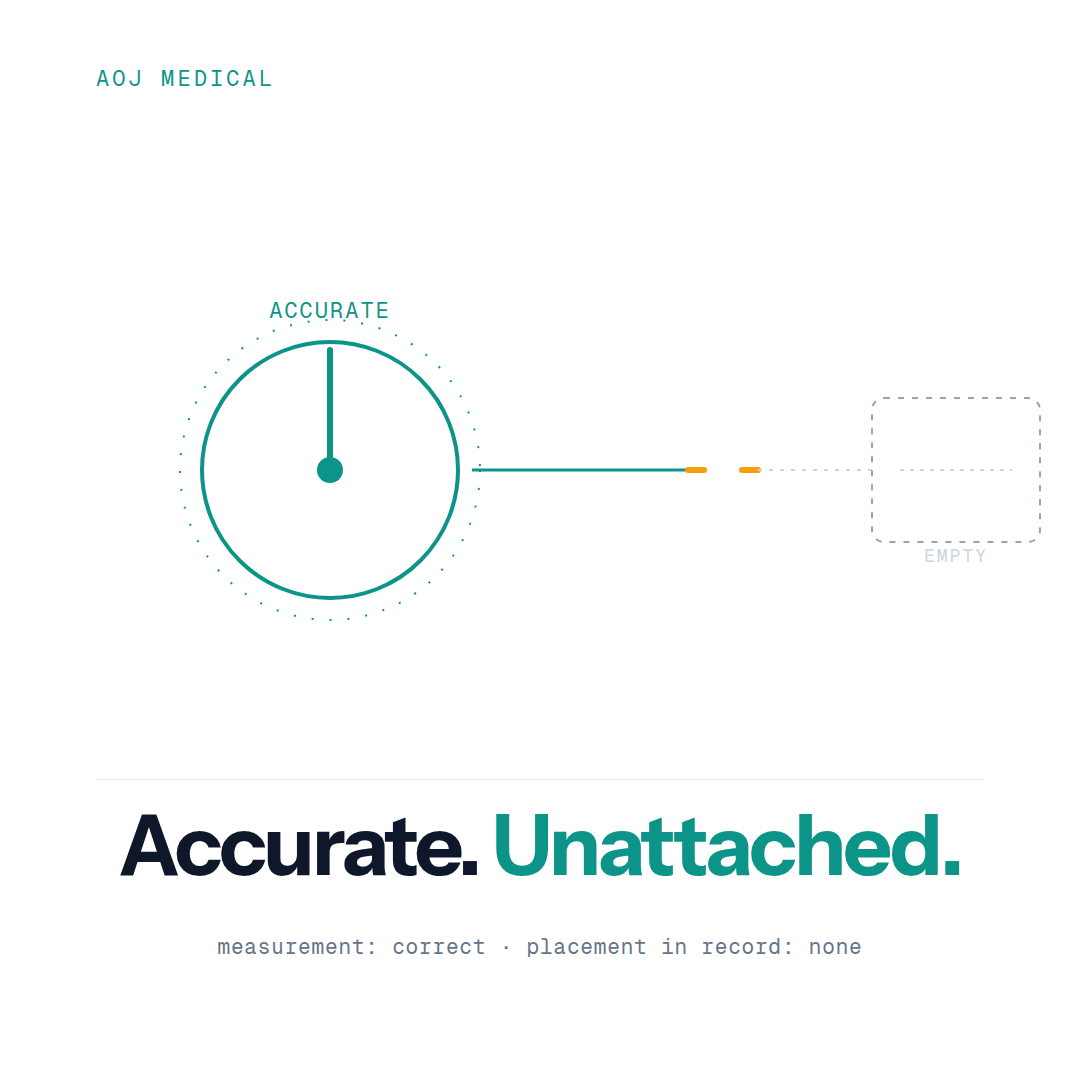
In a home care environment, a patient might wrap the blood pressure cuff incorrectly, a measurement may transmit without an authentic timestamp, or an internal patient ID might get swapped during cloud data ingestion. Even if the hardware sensor measured the physiological signal with 100% precision, the resulting clinical data becomes entirely unusable.
The 5 Key Pillars of RPM Data Quality
Reliable remote patient monitoring (RPM) systems depend on accurate, complete, and trustworthy healthcare data. These five data quality pillars help ensure that patient information remains accurate throughout measurement, transmission, and clinical analysis.
| Data Quality Pillar | Definition | Clinical Importance |
|---|---|---|
| 1. Measurement Accuracy | Ensures sensor devices capture precise physiological data through reliable measurement technology. | Improves the accuracy of patient health assessments and clinical decisions. |
| 2. Identity Integrity | Maintains correct patient-to-device matching and prevents data association errors. | Ensures healthcare providers review the correct patient’s information. |
| 3. Temporal Integrity | Records accurate timestamps for every remote monitoring measurement. | Supports reliable trend analysis and timely medical intervention. |
| 4. Transmission Integrity | Protects data transfer by preventing information loss, duplication, or corruption. | Maintains complete and consistent patient monitoring records. |
| 5. Artifact Detection | Identifies abnormal readings caused by device errors, environmental factors, or incorrect usage. | Helps clinicians distinguish real health changes from inaccurate data. |
By maintaining these five RPM data quality standards, healthcare providers can improve monitoring reliability, reduce false alerts, and make better-informed clinical decisions.
1. Identity Integrity: Preventing Patient-Device Mismatches
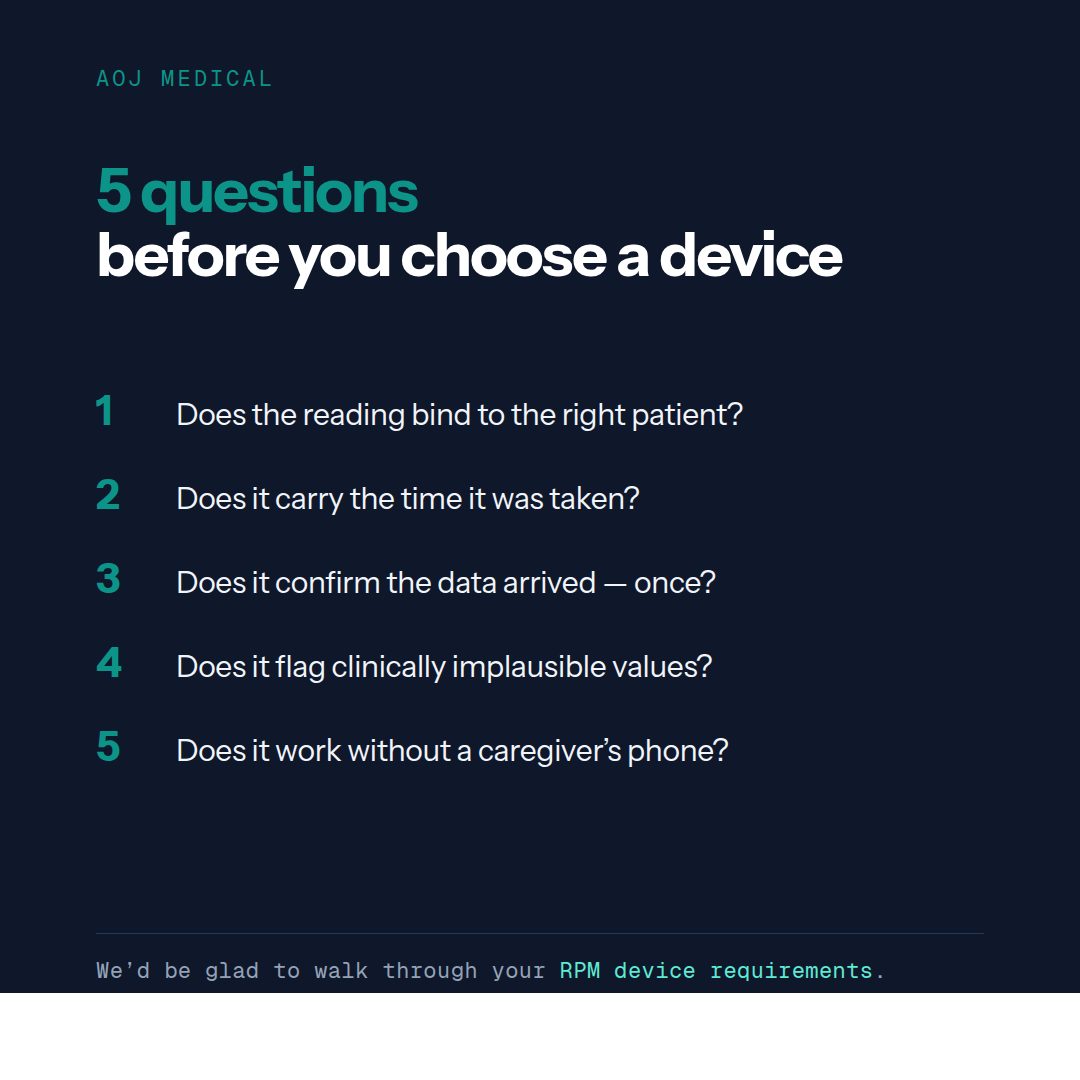
The fundamental question for any telemetry system is: Is this reading unequivocally from this specific patient?
In multi-user households or rapidly scaling chronic care management programs, devices get reassigned, IDs merge incorrectly during system updates, or patient assignment records get lost during cellular transmission. A precise blood pressure reading attached to the wrong patient record leads to improper clinical decisions and severe medical liability.
2. Temporal Integrity: Real-Time vs. Buffered Timestamps
Was this reading taken at the exact moment the timestamp claims it was?
When cellular or Bluetooth medical devices lose connectivity, readings are buffered locally on the hardware. If a device lacks an accurate internal real-time clock (RTC) or sync protocol, a batch of readings taken over three days might all be stamped with the single upload timestamp when reconnection occurs. This timestamp distortion hides critical circadian trends and skews clinical interventions.
3. Transmission Completeness: Eliminating Gaps and Duplicates
Did the physiological reading arrive intact at the Electronic Health Record (EHR) or RPM platform? More importantly, did it arrive only once?
Incomplete data packets create false gaps in care, triggering unnecessary outreach from care coordinators. Conversely, duplicate data packets artificially inflate daily or weekly physiological averages, misleading clinicians about medication efficacy.
4. Smart Artifact Detection: Flagging Clinical Implausibility
Can the device or firmware intelligently flag a measurement that is technically accurate according to sensor physics, but clinically implausible in practice?
For example, a patient reading displaying a blood pressure of 180/110 mmHg followed by 120/80 mmHg just two minutes later often indicates acute motion artifact or improper positioning rather than a true physiological change. Advanced medical device suppliers engineer algorithms that identify and flag these anomalies before they corrupt clinical dashboards.
Why AOJ Medical Prioritizes Comprehensive Data Integrity
A medical device that excels at basic sensor accuracy while ignoring identity, timing, transmission, and artifact detection is not a true RPM-ready device. It is simply a laboratory instrument that happens to have a wireless antenna attached.
At AOJ Medical, as a leading professional telehealth medical devices supplier, we dedicate as much engineering expertise to data architecture and payload integrity as we do to biomedical measurement accuracy.
We understand that in remote care programs, a number that looks accurate—but belongs to the wrong patient, was taken hours before its timestamp indicates, or was duplicated during API transmission—is significantly worse than receiving no data at all. Incorrect data leads to misdiagnoses, unnecessary emergency room visits, and eroded trust between patients and care teams.
If your RPM platform is working through data quality issues that don’t show up on a spec sheet, I’d be curious to hear what you’re seeing.