
For Remote Patient Monitoring (RPM) platform vendors, digital health procurement officers, and health system administrators, hardware sourcing decisions frequently default to initial unit cost. At first glance, Bluetooth Low Energy (BLE) temperature monitoring devices appear economically superior due to lower upfront hardware prices. However, evaluating hardware solely on purchase price ignores the true Total Cost of Ownership (TCO).
A central operational dilemma for digital health procurement is: “Bluetooth RPM devices cost significantly less per unit than 4G LTE cellular models—does the price difference justify the operational friction of app pairing, patient technical support, and data transmission loss?”
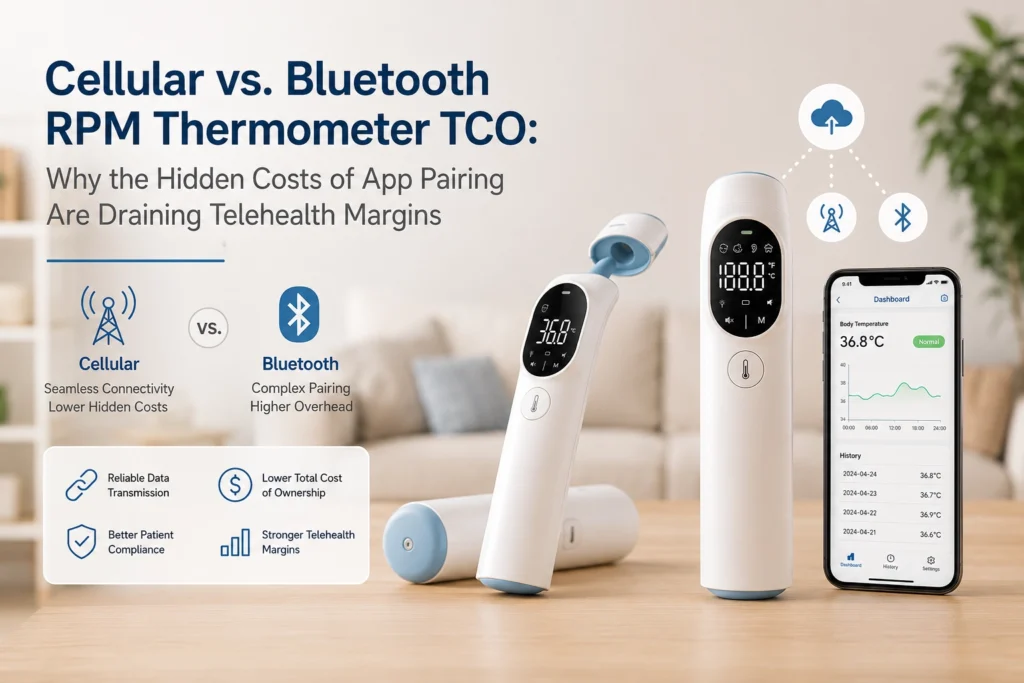
Recent clinical implementation data reveals that the operational friction of smartphone pairing, app downloads, and Wi-Fi pairing introduces massive structural barriers—especially among elderly and low-income patient cohorts. Evaluating the math of “Patient Churn Rate × Lost CPT Billing Reimbursement” demonstrates that cellular connected medical devices deliver a drastically lower TCO than Bluetooth alternatives.
The App Pairing Trap: Structural Friction in Digital Health Deployments
While tech-savvy populations navigate mobile apps with ease, the average RPM target demographic consists of elderly patients managing chronic conditions who frequently struggle with modern smartphone interfaces.
| Patient Onboarding Step | Bluetooth BLE RPM Device | 4G LTE Cellular RPM Device |
|---|---|---|
| Device Setup | Unpack and prepare the Bluetooth device | Unpack the cellular thermometer |
| Smartphone Required | Yes | No |
| App Installation | Required | Not required |
| Bluetooth Pairing | Required | Not required |
| Permission Setup | May require Bluetooth, location, and app permissions | No smartphone permissions required |
| Data Synchronization | Depends on smartphone and Bluetooth connection | Automatic cellular data transmission |
| Troubleshooting | Patients may need support for pairing or sync failures | Minimal technical support required |
| Patient Experience | Multiple setup steps can create friction | One-button, out-of-the-box operation |
| Support Burden | Higher due to app and Bluetooth troubleshooting | Lower due to automated connectivity |
| Data Transmission Risk | Higher if Bluetooth or app synchronization fails | Lower with automated cellular transmission |
A study published in The Journal of the American Board of Family Medicine examined RPM adoption across community health centers. Even when patients were provided with free cellular-enabled smartphones and monitoring hardware, overall long-term RPM engagement remained low due to technical complexity and institutional support burdens.
Every extra step required to take a measurement—launching an app, maintaining a active Bluetooth connection, re-authenticating credentials, or approving OS firmware updates—acts as a point of failure. When Bluetooth sync fails, physiological data fails to upload, directly threatening monthly compliance thresholds required for CPT code reimbursement.
Total Cost of Ownership (TCO) Framework: Cellular vs. Bluetooth RPM Devices
To evaluate the true economic impact of hardware selection, platform providers must look beyond initial device acquisition costs and calculate full operational lifecycle expenses.
| TCO Cost Factor | Bluetooth BLE RPM Thermometer | 4G LTE Cellular RPM Thermometer |
|---|---|---|
| Initial Device Cost | Approximately US $12–$20 | Approximately US $35–$55 |
| Patient Setup | Requires smartphone, app installation, Bluetooth pairing, and permissions | Out-of-the-box setup with one-button operation |
| Patient IT Support | High; approximately 20–45 minutes per patient may be required for setup and troubleshooting | Low; no smartphone pairing or app troubleshooting required |
| Estimated Support Labor | Approximately $15–$25 per 20-minute technical support call | Minimal additional patient IT support |
| Data Synchronization | Relies on Bluetooth and smartphone app connectivity | Automatic cellular transmission |
| Data Loss Risk | Higher when apps crash or Bluetooth connections fail | Lower due to automated cellular transmission |
| CPT 99454 Compliance Risk | Higher if insufficient physiological data transmissions are recorded | Lower when readings are automatically transmitted |
| Patient Churn Risk | Higher when patients experience repeated technical problems | Lower due to simpler patient workflow |
| Long-Term TCO | Lower acquisition cost but potentially higher operational costs | Higher acquisition cost but potentially lower lifecycle costs |
1. Patient Support IT Overhead Costs
When a Bluetooth device fails to pair, the patient calls the RPM platform’s support desk or health system helpline. Managing a single 20-minute technical support call costs an enterprise telehealth provider roughly $15 to $25 in support labor. A few support calls completely erase the initial purchase savings of a cheap Bluetooth device.
2. Protecting CPT 99454 and CPT 99453 Reimbursement
Under US Medicare reimbursement guidelines:
CPT 99453: Covers initial setup and patient education.
CPT 99454: Requires at least 16 days of physiological data transmissions within a 30-day period to qualify for monthly reimbursement (~$45–$55/patient/month).
If a patient’s Bluetooth app fails to sync for just a few days out of the month, the health system loses 100% of that month’s CPT 99454 billing revenue. Cellular devices automatically transmit readings immediately after measurement, ensuring high data compliance without relying on patient smartphone intervention.
Clinical Accuracy and Multi-Carrier Connectivity Infrastructure
Engineered specifically for institutional telehealth deployments, clinical-grade cellular hardware bridges the gap between patient-led home usability and backend software integration.
| System Layer | AOJ Cellular RPM Solution | Primary Function |
|---|---|---|
| Patient Measurement | One-button infrared thermometer | Captures temperature readings |
| Clinical Sensor | Infrared thermal sensor array | Measures temperature across supported measurement modes |
| Cellular Connectivity | Integrated multi-carrier IoT SIM | Transmits patient readings without smartphone pairing |
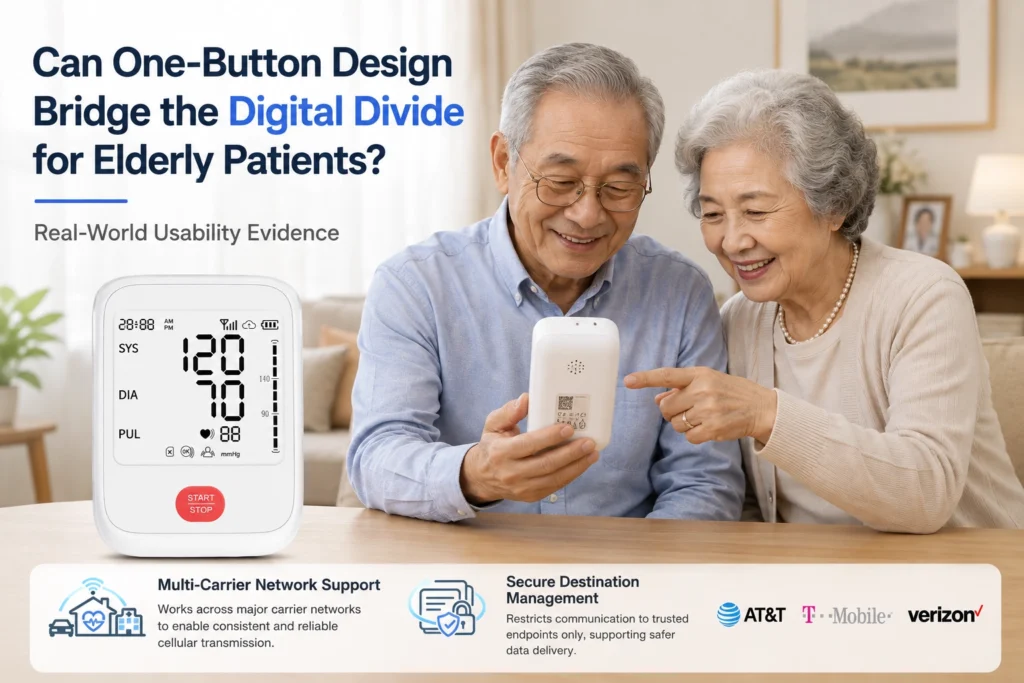
| US Network Coverage | AT&T, T-Mobile, Verizon | Provides cellular connectivity across supported networks |
| Data Security | Encrypted M2M/IoT transmission | Protects transmitted patient telemetry |
| API/SDK Layer | Developer API and SDK | Connects device data with third-party RPM platforms |
| Backend Platform | RPM / EHR dashboard | Receives and displays patient temperature data |
1. Medical-Grade Precision & Regulatory Clearance
AOJ’s 4G LTE-enabled Infrared Thermometer portfolio holds FDA 510(k) clearance (K221039). Built around advanced clinical-grade infrared thermal array sensors, the devices support versatile diagnostic modes—including adult forehead, ear, and object measurement—alongside age-gated logic for pediatric tracking.
2. Multi-Carrier US Cellular IoT Coverage
Each unit features an integrated multi-carrier IoT SIM card that automatically connects to top-tier US cellular networks (AT&T, T-Mobile, Verizon). By utilizing dedicated, encrypted M2M/IoT cellular frequencies, readings are securely routed directly to your cloud infrastructure—even in rural or low-bandwidth environments.
3. Developer-Ready Software Integration
AOJ provides a complete API/SDK documentation package, enabling engineering teams to quickly map patient telemetry—including raw temperature readings, measurement modes, timestamped memory logs, and low-battery alerts—directly into custom EHR and RPM dashboards.
Summary and Sourcing Strategy for Telehealth Buyers
While Bluetooth RPM hardware boasts a lower upfront purchase price, its hidden operational costs—high support labor, elevated patient churn, and lost CPT 99454 billing due to missed transmissions—make it significantly more expensive over a patient’s care lifecycle. Sourcing zero-setup 4G LTE cellular medical devices eliminates technical friction, protects monthly reimbursement compliance, and lowers the true Total Cost of Ownership for enterprise digital health providers.
Enterprise Telehealth Solutions from AOJ Medical
As a premier institutional Telehealth Equipment Provider, AOJ supplies clinical-grade cellular medical devices designed specifically for RPM platform providers, health systems, and B2B medical buyers across the United States.
Zero-Setup 4G LTE Cellular Thermometer: Eliminates Bluetooth pairing, Wi-Fi configuration, and app downloads, delivering an instant “out-of-the-box” experience that drives high patient compliance.
FDA 510(k) Cleared Diagnostic Precision: Features high-accuracy infrared thermal array sensors with versatile 3-in-1 measurement modes (Adult Forehead, Ear, Child, and Object) and audio/silent toggle settings.
Complete API/SDK Integration Support: Backed by comprehensive developer documentation and encrypted multi-carrier IoT connectivity (AT&T, T-Mobile, Verizon) for seamless RESTful API integration into enterprise RPM platforms.
Lower your platform’s operational churn and secure CPT billing compliance. Contact the B2B telehealth engineering team at AOJ Medical today to request sample units and API documentation!